Difference between pages "F-84G-21-RE" and "Seafire F Mk XVII"
(Edits) |
(→External links) (Tag: Visual edit) |
||
| Line 1: | Line 1: | ||
{{About | {{About | ||
| − | |about= | + | | about = British naval fighter '''{{PAGENAME}}''' |
| − | |usage=other versions | + | | other |
| − | |link= | + | | usage-1 = the other navalised Spitfire |
| + | | link-1 = Seafire FR 47 | ||
| + | | usage-2 = other versions | ||
| + | | link-2 = Spitfire (Family) | ||
}} | }} | ||
{{Specs-Card | {{Specs-Card | ||
| − | |code= | + | |code=seafire_mk17 |
|images={{Specs-Card-Image|GarageImage_{{PAGENAME}}.jpg}} | |images={{Specs-Card-Image|GarageImage_{{PAGENAME}}.jpg}} | ||
| − | |||
}} | }} | ||
== Description == | == Description == | ||
<!-- ''In the description, the first part should be about the history of and the creation and combat usage of the aircraft, as well as its key features. In the second part, tell the reader about the aircraft in the game. Insert a screenshot of the vehicle, so that if the novice player does not remember the vehicle by name, he will immediately understand what kind of vehicle the article is talking about.'' --> | <!-- ''In the description, the first part should be about the history of and the creation and combat usage of the aircraft, as well as its key features. In the second part, tell the reader about the aircraft in the game. Insert a screenshot of the vehicle, so that if the novice player does not remember the vehicle by name, he will immediately understand what kind of vehicle the article is talking about.'' --> | ||
| − | The '''{{Specs|name}}''' is a rank {{Specs|rank}} | + | The '''{{Specs|name}}''' is a rank {{Specs|rank}} British naval fighter {{Battle-rating}}. It was introduced in [[Update 1.49 "Weapons of Victory"]]. |
| − | + | The first thing to know is that the XVII is a low altitude fighter, unlike the next Seafire - the [[Seafire FR 47|FR 47]] which is a high altitude fighter. Climb rate is fantastic until 2,500 m, where it can still perform quite well until 3,500 m but going over is not recommended as the engine will fail to provide enough power. It is recommended to climb at the beginning of the game until 2,000 m, targeting enemy Attacker aircraft, retreating, climbing up to 3,500 m, baiting down enemy fighters and finishing them on your own turf (under 2,000 m). | |
| − | + | The Seafire Mk XVII has excellent manoeuvrability, stock turn time is 18.3 s (AB) and 18.6 s (RB/SB) and once fully upgraded it reaches 16.6 s (AB) and 17 s (RB/SB). Once the first pass of an enemy is dodged, sticking to its tail is not a difficult task as it can out turn many of its opponents especially Germans and Americans. | |
| − | + | Stock, the plane is very difficult to handle, the climb rate is average (17 m/s in AB, 19.5 m/s in RB/SB), energy retention is lacking, ammunition is ineffective, speed isn't as high as its contemporaries (603 km/h max speed in AB, 586 km/h max speed in AB/SB). Players will have a bitter time unlocking each and every module of the plane and should stick to a boom and zoom strategy until the performance modules are fully unlocked and installed. The 20 mm ammo belts should be researched as soon as it is available to research, but focusing on performance upgrades is the key, 7.7 mm and bombs should be left as the last modules to unlock. Stock, the plane is not worth playing in RB, play it in AB until you have at least unlocked all the performance modules. | |
| − | + | The 2 x Hispano Mk.V 20 mm guns are much more effective once the air belt is equipped, composed of 1 tracer round followed by a twice-repeating sequence of 1 HEI and 1 SAP-I round (T/HEI/SAP-I/HEI/SAP-I) it wrecks others fighters in small bursts and does not require much more for medium bombers if used at a convergence point. On the other hand the 7.7 mm appears like an archaic weapon, ineffective but kept as a souvenir of the "good old days" of the Spitfire Mk Ia. Whilst ineffective, they can be used as a guide for the 20 mm Stealth belts should one decide to use them. | |
| + | |||
| + | Unfortunately the plane is lacking rockets for ground attacks like its elder brother the Seafire FR 47, nevertheless, it can equip up to 2 x 250 lb + 500 lb bombs which are enough to easily destroy medium tanks or finish a damaged base. The payload is useful in late RB game but it should be avoided to start a game with as it affects performance significantly. | ||
== General info == | == General info == | ||
| Line 26: | Line 30: | ||
{{Specs-Avia-Flight}} | {{Specs-Avia-Flight}} | ||
<!-- ''Describe how the aircraft behaves in the air. Speed, manoeuvrability, acceleration and allowable loads - these are the most important characteristics of the vehicle.'' --> | <!-- ''Describe how the aircraft behaves in the air. Speed, manoeuvrability, acceleration and allowable loads - these are the most important characteristics of the vehicle.'' --> | ||
| − | |||
| − | |||
| − | |||
| − | |||
| − | |||
| − | |||
{| class="wikitable" style="text-align:center" width="70%" | {| class="wikitable" style="text-align:center" width="70%" | ||
! rowspan="2" | Characteristics | ! rowspan="2" | Characteristics | ||
| − | ! colspan="2" | Max Speed<br>(km/h at | + | ! colspan="2" | Max Speed<br>(km/h at 3,962 m) |
! rowspan="2" | Max altitude<br>(metres) | ! rowspan="2" | Max altitude<br>(metres) | ||
! colspan="2" | Turn time<br>(seconds) | ! colspan="2" | Turn time<br>(seconds) | ||
| Line 44: | Line 42: | ||
|- | |- | ||
! Stock | ! Stock | ||
| − | | | + | | 606 || 585 || rowspan="2" | {{Specs|ceiling}} || 18.0 || 18.7 || 19.5 || 19.5 || rowspan="2" | 480 |
|- | |- | ||
! Upgraded | ! Upgraded | ||
| − | | | + | | 676 || 635 || 16.3 || 17.0 || 31.0 || 24.2 |
|- | |- | ||
|} | |} | ||
| Line 54: | Line 52: | ||
{| class="wikitable" style="text-align:center" width="50%" | {| class="wikitable" style="text-align:center" width="50%" | ||
|- | |- | ||
| − | ! colspan=" | + | ! colspan="5" | Features |
|- | |- | ||
| − | ! Combat flaps !! Take-off flaps !! Landing flaps !! Air brakes !! Arrestor gear | + | ! Combat flaps !! Take-off flaps !! Landing flaps !! Air brakes !! Arrestor gear |
|- | |- | ||
| − | | | + | | X || X || ✓ || X || ✓ <!-- ✓ --> |
|- | |- | ||
|} | |} | ||
| Line 73: | Line 71: | ||
! Combat !! Take-off !! Landing !! + !! - | ! Combat !! Take-off !! Landing !! + !! - | ||
|- | |- | ||
| − | | {{Specs|destruction|body}} || {{Specs|destruction|gear}} || | + | | {{Specs|destruction|body}} || {{Specs|destruction|gear}} || N/A || N/A || 260 || ~10 || ~6 |
|- | |- | ||
|} | |} | ||
| Line 83: | Line 81: | ||
! Ailerons !! Rudder !! Elevators !! Radiator | ! Ailerons !! Rudder !! Elevators !! Radiator | ||
|- | |- | ||
| − | | < | + | | < 321 || < 400 || < 350 || > 500 |
|- | |- | ||
|} | |} | ||
| − | |||
{| class="wikitable" style="text-align:center" | {| class="wikitable" style="text-align:center" | ||
|- | |- | ||
| − | ! colspan="3" | | + | ! colspan="3" | Compressor (RB/SB) |
| − | |||
| − | |||
| − | |||
| − | |||
| − | |||
| − | |||
| − | |||
|- | |- | ||
| − | ! colspan="3" | | + | ! colspan="3" | Setting 1 |
| − | |||
|- | |- | ||
| − | ! | + | ! Optimal altitude |
| − | ! | + | ! 100% Engine power |
| + | ! WEP Engine power | ||
|- | |- | ||
| − | | 1, | + | | 1,880 m || 1,480 hp || 1,953 hp |
| − | |||
|- | |- | ||
| − | ! colspan="3" | | + | ! colspan="3" | Setting 2 |
| − | |||
|- | |- | ||
| − | ! | + | ! Optimal altitude |
| − | ! | + | ! 100% Engine power |
| + | ! WEP Engine power | ||
|- | |- | ||
| − | | | + | | 4,200 m || 1,350 hp || 1,782 hp |
| − | |||
| − | |||
| − | |||
| − | |||
|- | |- | ||
|} | |} | ||
| Line 126: | Line 111: | ||
<!-- ''Examine the survivability of the aircraft. Note how vulnerable the structure is and how secure the pilot is, whether the fuel tanks are armoured, etc. Describe the armour, if there is any, and also mention the vulnerability of other critical aircraft systems.'' --> | <!-- ''Examine the survivability of the aircraft. Note how vulnerable the structure is and how secure the pilot is, whether the fuel tanks are armoured, etc. Describe the armour, if there is any, and also mention the vulnerability of other critical aircraft systems.'' --> | ||
| − | * 38 mm Bulletproof glass | + | * 38 mm Bulletproof glass - Armoured windscreen |
| − | * | + | * 4 mm Steel - Armoured plates in the pilot seat |
| − | * | + | * 6-7 mm Steel - Armoured plates behind pilot's seat |
| − | * | + | * 1 mm Steel - Armoured plate between fuel tanks |
| − | + | * 3 mm Steel - Armoured boxes around wing ammunition | |
| − | |||
| − | |||
| − | |||
| − | |||
| − | |||
=== Modifications and economy === | === Modifications and economy === | ||
| Line 145: | Line 125: | ||
{{Specs-Avia-Offensive}} | {{Specs-Avia-Offensive}} | ||
<!-- ''Describe the offensive armament of the aircraft, if any. Describe how effective the cannons and machine guns are in a battle, and also what belts or drums are better to use. If there is no offensive weaponry, delete this subsection.'' --> | <!-- ''Describe the offensive armament of the aircraft, if any. Describe how effective the cannons and machine guns are in a battle, and also what belts or drums are better to use. If there is no offensive weaponry, delete this subsection.'' --> | ||
| − | {{main| | + | {{main|Hispano Mk.V (20 mm)|Browning (7.7 mm)}} |
The '''''{{PAGENAME}}''''' is armed with: | The '''''{{PAGENAME}}''''' is armed with: | ||
| − | * | + | * 2 x 20 mm Hispano Mk.V cannons, wing-mounted (120 rpg = 240 total) |
| − | * | + | * 4 x 7.7 mm Browning machine guns, wing-mounted (350 rpg = 1,400 total) |
| − | |||
| − | |||
| − | |||
| − | |||
=== Suspended armament === | === Suspended armament === | ||
{{Specs-Avia-Suspended}} | {{Specs-Avia-Suspended}} | ||
<!-- ''Describe the aircraft's suspended armament: additional cannons under the wings, bombs, rockets and torpedoes. This section is especially important for bombers and attackers. If there is no suspended weaponry remove this subsection.'' --> | <!-- ''Describe the aircraft's suspended armament: additional cannons under the wings, bombs, rockets and torpedoes. This section is especially important for bombers and attackers. If there is no suspended weaponry remove this subsection.'' --> | ||
| − | {{main| | + | {{main|G.P. Mk.IV (250 lb)|G.P. Mk.IV (500 lb)}} |
| − | |||
The '''''{{PAGENAME}}''''' can be outfitted with the following ordnance: | The '''''{{PAGENAME}}''''' can be outfitted with the following ordnance: | ||
* Without load | * Without load | ||
| − | + | * 2 x 250 lb G.P. Mk.IV bombs (500 lb total) | |
| − | * 2 x 250 lb | + | * 3 x 250 lb G.P. Mk.IV bombs (750 lb total) |
| − | * | + | * 1 x 500 lb G.P. Mk.IV bomb + 2 x 250 lb G.P. Mk.IV bombs (1,000 lb total) |
| − | * | ||
| − | |||
| − | |||
| − | |||
| − | |||
| − | |||
| − | |||
| − | |||
| − | |||
| − | |||
| − | |||
| − | |||
== Usage in battles == | == Usage in battles == | ||
<!-- ''Describe the tactics of playing in the aircraft, the features of using aircraft in a team and advice on tactics. Refrain from creating a "guide" - do not impose a single point of view, but instead, give the reader food for thought. Examine the most dangerous enemies and give recommendations on fighting them. If necessary, note the specifics of the game in different modes (AB, RB, SB).'' --> | <!-- ''Describe the tactics of playing in the aircraft, the features of using aircraft in a team and advice on tactics. Refrain from creating a "guide" - do not impose a single point of view, but instead, give the reader food for thought. Examine the most dangerous enemies and give recommendations on fighting them. If necessary, note the specifics of the game in different modes (AB, RB, SB).'' --> | ||
| + | The Seafire F Mk XVII is a fighter that does best at low altitudes. Here, below 2,500 m, it climbs exceptionally well, and its engine has a great power output, but as soon as the plane passes that altitude, engine power begins to fall significantly. The best performance is had below 2,000 m of altitude, and above 3,500 m, engine performance is very much inadequate. Because of this, it is wise to pick and choose which engagements to commit to. It is often unwise to attack heavy bombers, both because the Seafire's armament can be lacking against such large enemies and because heavy bombers are usually found at high altitudes, where the Seafire's performance is greatly hampered. Instead, low-altitude dogfights are where the Seafire shines. It can also be used to defend ground units against enemy ground-attackers. | ||
| − | + | This vehicle has excellent manoeuvrability like so many other British fighters. With such control, the pilot will have no trouble keeping on an enemy's tail. And, the plane can certainly handle itself in a one on one dogfight. | |
| − | |||
| − | |||
| − | |||
| − | |||
| − | |||
| − | |||
| − | |||
| − | |||
| − | |||
| − | |||
| − | |||
| − | |||
| − | |||
| − | |||
| − | |||
| − | |||
| − | |||
| − | |||
| − | |||
| − | |||
| − | |||
| − | |||
| − | The | + | The Seafire is armed with 2 x 20 mm cannons and 4 x 7.7 mm machine guns. The 20 mm cannons can pull their weight, but are limited by a rather small ammo count. So, trigger discipline is necessary and spraying at enemies is not recommended. Instead, it's often better to get close and aim precisely, firing in short bursts to conserve ammo. The 7.7 mm machine guns have more ammunition than the cannons, and can last quite a bit longer. Alone, they won't do much damage against enemy planes, but they can destroy unarmoured ground targets. Also, the 7.7 mm machine guns can be fired independently of the cannons, and looking at the path of the rounds can help the pilot to lead and aim the more powerful 20 mm cannons. This is especially useful if the enemy is farther away and flying in a relatively straight line. |
| − | The | + | The Seafire is able to carry up to 1,000 lbs of bombs, which can be used in either Air Realistic battles to destroy armoured ground targets, or in Ground Realistic battles, where they can be used for ground-attack to great effect. And once the bombs have been dropped, the Seafire can act as a great air superiority fighter in mixed battles. Additionally, it can use its 7.7 mm machine guns to spot ground targets for teammates on the ground to destroy. |
| − | |||
| − | |||
| − | |||
| − | |||
| − | |||
| − | |||
| − | |||
| + | === Manual Engine Control === | ||
{| class="wikitable" style="text-align:center" | {| class="wikitable" style="text-align:center" | ||
| − | |||
|- | |- | ||
| − | ! | + | ! colspan="7" | MEC elements |
| − | |||
| − | |||
| − | |||
|- | |- | ||
| − | | 2 | + | ! rowspan="2" | Mixer |
| + | ! rowspan="2" | Pitch | ||
| + | ! colspan="3" | Radiator | ||
| + | ! rowspan="2" | Supercharger | ||
| + | ! rowspan="2" | Turbocharger | ||
| + | |- | ||
| + | ! Oil !! Water !! Type | ||
| + | |- | ||
| + | | Not controllable || Controllable<br>Not auto controlled || Not controllable<br>Not auto controlled || Controllable<br>Auto control available || Combined || Controllable<br>2 gears || Not controllable | ||
|- | |- | ||
|} | |} | ||
| Line 233: | Line 173: | ||
=== Pros and cons === | === Pros and cons === | ||
<!-- ''Summarise and briefly evaluate the vehicle in terms of its characteristics and combat effectiveness. Mark its pros and cons in the bulleted list. Try not to use more than 6 points for each of the characteristics. Avoid using categorical definitions such as "bad", "good" and the like - use substitutions with softer forms such as "inadequate" and "effective".'' --> | <!-- ''Summarise and briefly evaluate the vehicle in terms of its characteristics and combat effectiveness. Mark its pros and cons in the bulleted list. Try not to use more than 6 points for each of the characteristics. Avoid using categorical definitions such as "bad", "good" and the like - use substitutions with softer forms such as "inadequate" and "effective".'' --> | ||
| + | [[File:Seafire at night.jpg|thumbnail|right|Seafire XVII on a night sortie]] | ||
'''Pros:''' | '''Pros:''' | ||
| − | * | + | * Very manoeuvrable |
| − | * | + | * Good bomb load for a Spitfire: up to 2 x 250 lb + 500 lb bombs |
| − | * Good | + | * Good climb rate at low altitudes |
| − | |||
| − | |||
| − | |||
'''Cons:''' | '''Cons:''' | ||
| − | * | + | * Poor high-altitude performance |
| − | + | * .303 calibre machine guns do little damage | |
| − | + | * Low cannon ammunition count | |
| − | * | ||
| − | * | ||
| − | |||
== History == | == History == | ||
<!-- ''Describe the history of the creation and combat usage of the aircraft in more detail than in the introduction. If the historical reference turns out to be too long, take it to a separate article, taking a link to the article about the vehicle and adding a block "/History" (example: <nowiki>https://wiki.warthunder.com/(Vehicle-name)/History</nowiki>) and add a link to it here using the <code>main</code> template. Be sure to reference text and sources by using <code><nowiki><ref></ref></nowiki></code>, as well as adding them at the end of the article with <code><nowiki><references /></nowiki></code>. This section may also include the vehicle's dev blog entry (if applicable) and the in-game encyclopedia description (under <code><nowiki>=== In-game description ===</nowiki></code>, also if applicable).'' --> | <!-- ''Describe the history of the creation and combat usage of the aircraft in more detail than in the introduction. If the historical reference turns out to be too long, take it to a separate article, taking a link to the article about the vehicle and adding a block "/History" (example: <nowiki>https://wiki.warthunder.com/(Vehicle-name)/History</nowiki>) and add a link to it here using the <code>main</code> template. Be sure to reference text and sources by using <code><nowiki><ref></ref></nowiki></code>, as well as adding them at the end of the article with <code><nowiki><references /></nowiki></code>. This section may also include the vehicle's dev blog entry (if applicable) and the in-game encyclopedia description (under <code><nowiki>=== In-game description ===</nowiki></code>, also if applicable).'' --> | ||
| − | + | {{break}} | |
| + | {{Navigation-Start|{{Annotation|Archive of the in-game description|An archive of the historical description of the vehicle that was presented in-game prior to Update 1.55 'Royal Armour'}}|expand=true}} | ||
| + | {{Navigation-First-Simple-Line}} | ||
| + | By late 1944 the Seafire had already seen a number of major components changes, modifications and variations. The previous Seafire, the Mk.XV, came immediately after the Mk.III and was named thus in an attempt to standardize with the Spitfire lineage. Westland had taken a Seafire Mk.XV and, after some trial and error with various canopies, followed the progression of the Spitfire family and fitted a high visibility teardrop canopy along with a modified rear fuselage. The last 30 Seafire Mk.XVs therefore acted as an interim transition marque into the new Seafire Mk.XVII. | ||
| − | The | + | The Mk.XVII also included a number of further modifications – perhaps most importantly, the undercarriage was significantly improved for carrier operations. Previous Seafires had been forced to persevere with what was effectively a Spitfire undercarriage, designed for operating from grass strips with an aircraft some three quarters of a ton lighter. The new undercarriage was strengthened for the heavier Seafire and also made longer; not only did this new deck clearance make landing safer and easier, it also permitted greater operating weights which allowed the Seafire Mk.XVII to carry more fuel and ordnance. |
| − | + | The cut down, lighter rear fuselage also allowed an additional internal fuel tank, or reconnaissance cameras. The overall strengthening of the airframe allowed installation of further hard points, and the Seafire Mk.XVII could now carry double the number of rockets and bombs, with a 250 lb bomb now being carried under each wing in addition to the centerline 500 lb bomb. Air to air weaponry remained the same as previous Seafires, with two 20 mm Hispano Mk.V cannon and four 0.303 Browning machine guns. An enlarged tail fin also led to increased stability and improved handling characteristics. | |
| − | + | The same Rolls-Royce Griffon VI that powered the previous Seafire Mk.XV was also used in the Mk.XVII. This was a single-stage, two-speed supercharger engine which gave 1,815 hp at 4,500 feet with +15 lbs of boost. The Seafire Mk.XVII reached its top speed of 383 mph at 23,000 feet – slightly quicker than the Mk.XV at all heights, but the rate of climb was slightly less impressive. | |
| − | + | 807 Naval Air Squadron was the first squadron to receive the new Seafire Mk.XVII in December 1945 after returning to Britain from the Far East. With a total of 232 fighters equipping five front line squadrons and a number of reserve, training and second line squadrons, the Seafire Mk.XVII was finally retired in late 1954. | |
| − | + | {{Navigation-End}} | |
| − | |||
| − | |||
| − | |||
| − | |||
== Media == | == Media == | ||
| Line 274: | Line 208: | ||
;Skins | ;Skins | ||
| − | * [https://live.warthunder.com/feed/camouflages/?vehicle= | + | |
| + | * [https://live.warthunder.com/feed/camouflages/?vehicle=seafire_mk17 Skins and camouflages for the {{PAGENAME}} from live.warthunder.com.] | ||
== See also == | == See also == | ||
| − | + | ''Links to the articles on the War Thunder Wiki that you think will be useful for the reader, for example:'' | |
| + | |||
* ''reference to the series of the aircraft;'' | * ''reference to the series of the aircraft;'' | ||
| − | * ''links to approximate analogues of other nations and research trees.'' | + | * ''links to approximate analogues of other nations and research trees.'' |
| − | |||
| − | |||
| − | |||
| − | |||
| − | |||
| − | |||
| − | |||
| − | |||
| − | |||
| − | |||
| − | |||
| − | |||
| − | |||
| − | |||
| − | |||
== External links == | == External links == | ||
| − | <!-- ''Paste links to sources and external resources, such as:'' | + | <!--''Paste links to sources and external resources, such as:'' |
* ''topic on the official game forum;'' | * ''topic on the official game forum;'' | ||
| − | * ''other literature.'' --> | + | * ''other literature.''--> |
| − | |||
| − | |||
| − | + | * [https://old-forum.warthunder.com/index.php?/topic/235719-supermarine-seafire-f-mk-xvii/ Official data sheet - more details about the performance] | |
| − | |||
| − | |||
| − | |||
| − | {{AirManufacturer | + | {{AirManufacturer Supermarine}} |
| − | {{ | + | {{Britain fighters}} |
Latest revision as of 01:13, 19 October 2023
| This page is about the British naval fighter Seafire F Mk XVII. For the other navalised Spitfire, see Seafire FR 47. For other versions, see Spitfire (Family). |

Contents
Description
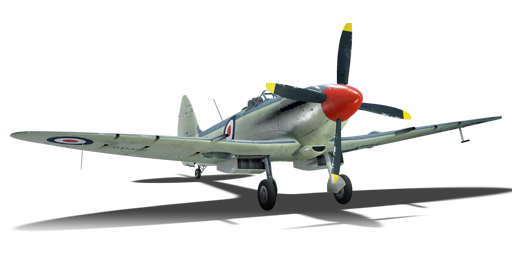
The Seafire F Mk XVII is a rank British naval fighter with a battle rating of (AB), (RB), and (SB). It was introduced in Update 1.49 "Weapons of Victory".
The first thing to know is that the XVII is a low altitude fighter, unlike the next Seafire - the FR 47 which is a high altitude fighter. Climb rate is fantastic until 2,500 m, where it can still perform quite well until 3,500 m but going over is not recommended as the engine will fail to provide enough power. It is recommended to climb at the beginning of the game until 2,000 m, targeting enemy Attacker aircraft, retreating, climbing up to 3,500 m, baiting down enemy fighters and finishing them on your own turf (under 2,000 m).
The Seafire Mk XVII has excellent manoeuvrability, stock turn time is 18.3 s (AB) and 18.6 s (RB/SB) and once fully upgraded it reaches 16.6 s (AB) and 17 s (RB/SB). Once the first pass of an enemy is dodged, sticking to its tail is not a difficult task as it can out turn many of its opponents especially Germans and Americans.
Stock, the plane is very difficult to handle, the climb rate is average (17 m/s in AB, 19.5 m/s in RB/SB), energy retention is lacking, ammunition is ineffective, speed isn't as high as its contemporaries (603 km/h max speed in AB, 586 km/h max speed in AB/SB). Players will have a bitter time unlocking each and every module of the plane and should stick to a boom and zoom strategy until the performance modules are fully unlocked and installed. The 20 mm ammo belts should be researched as soon as it is available to research, but focusing on performance upgrades is the key, 7.7 mm and bombs should be left as the last modules to unlock. Stock, the plane is not worth playing in RB, play it in AB until you have at least unlocked all the performance modules.
The 2 x Hispano Mk.V 20 mm guns are much more effective once the air belt is equipped, composed of 1 tracer round followed by a twice-repeating sequence of 1 HEI and 1 SAP-I round (T/HEI/SAP-I/HEI/SAP-I) it wrecks others fighters in small bursts and does not require much more for medium bombers if used at a convergence point. On the other hand the 7.7 mm appears like an archaic weapon, ineffective but kept as a souvenir of the "good old days" of the Spitfire Mk Ia. Whilst ineffective, they can be used as a guide for the 20 mm Stealth belts should one decide to use them.
Unfortunately the plane is lacking rockets for ground attacks like its elder brother the Seafire FR 47, nevertheless, it can equip up to 2 x 250 lb + 500 lb bombs which are enough to easily destroy medium tanks or finish a damaged base. The payload is useful in late RB game but it should be avoided to start a game with as it affects performance significantly.
General info
Flight performance
| Characteristics | Max Speed (km/h at 3,962 m) |
Max altitude (metres) |
Turn time (seconds) |
Rate of climb (metres/second) |
Take-off run (metres) | |||
|---|---|---|---|---|---|---|---|---|
| AB | RB | AB | RB | AB | RB | |||
| Stock | 606 | 585 | 18.0 | 18.7 | 19.5 | 19.5 | 480 | |
| Upgraded | 676 | 635 | 16.3 | 17.0 | 31.0 | 24.2 | ||
Details
| Features | ||||
|---|---|---|---|---|
| Combat flaps | Take-off flaps | Landing flaps | Air brakes | Arrestor gear |
| X | X | ✓ | X | ✓ |
| Limits | ||||||
|---|---|---|---|---|---|---|
| Wings (km/h) | Gear (km/h) | Flaps (km/h) | Max Static G | |||
| Combat | Take-off | Landing | + | - | ||
| N/A | N/A | 260 | ~10 | ~6 | ||
| Optimal velocities (km/h) | |||
|---|---|---|---|
| Ailerons | Rudder | Elevators | Radiator |
| < 321 | < 400 | < 350 | > 500 |
| Compressor (RB/SB) | ||
|---|---|---|
| Setting 1 | ||
| Optimal altitude | 100% Engine power | WEP Engine power |
| 1,880 m | 1,480 hp | 1,953 hp |
| Setting 2 | ||
| Optimal altitude | 100% Engine power | WEP Engine power |
| 4,200 m | 1,350 hp | 1,782 hp |
Survivability and armour
- 38 mm Bulletproof glass - Armoured windscreen
- 4 mm Steel - Armoured plates in the pilot seat
- 6-7 mm Steel - Armoured plates behind pilot's seat
- 1 mm Steel - Armoured plate between fuel tanks
- 3 mm Steel - Armoured boxes around wing ammunition
Modifications and economy
Armaments
Offensive armament
The Seafire F Mk XVII is armed with:
- 2 x 20 mm Hispano Mk.V cannons, wing-mounted (120 rpg = 240 total)
- 4 x 7.7 mm Browning machine guns, wing-mounted (350 rpg = 1,400 total)
Suspended armament
The Seafire F Mk XVII can be outfitted with the following ordnance:
- Without load
- 2 x 250 lb G.P. Mk.IV bombs (500 lb total)
- 3 x 250 lb G.P. Mk.IV bombs (750 lb total)
- 1 x 500 lb G.P. Mk.IV bomb + 2 x 250 lb G.P. Mk.IV bombs (1,000 lb total)
Usage in battles
The Seafire F Mk XVII is a fighter that does best at low altitudes. Here, below 2,500 m, it climbs exceptionally well, and its engine has a great power output, but as soon as the plane passes that altitude, engine power begins to fall significantly. The best performance is had below 2,000 m of altitude, and above 3,500 m, engine performance is very much inadequate. Because of this, it is wise to pick and choose which engagements to commit to. It is often unwise to attack heavy bombers, both because the Seafire's armament can be lacking against such large enemies and because heavy bombers are usually found at high altitudes, where the Seafire's performance is greatly hampered. Instead, low-altitude dogfights are where the Seafire shines. It can also be used to defend ground units against enemy ground-attackers.
This vehicle has excellent manoeuvrability like so many other British fighters. With such control, the pilot will have no trouble keeping on an enemy's tail. And, the plane can certainly handle itself in a one on one dogfight.
The Seafire is armed with 2 x 20 mm cannons and 4 x 7.7 mm machine guns. The 20 mm cannons can pull their weight, but are limited by a rather small ammo count. So, trigger discipline is necessary and spraying at enemies is not recommended. Instead, it's often better to get close and aim precisely, firing in short bursts to conserve ammo. The 7.7 mm machine guns have more ammunition than the cannons, and can last quite a bit longer. Alone, they won't do much damage against enemy planes, but they can destroy unarmoured ground targets. Also, the 7.7 mm machine guns can be fired independently of the cannons, and looking at the path of the rounds can help the pilot to lead and aim the more powerful 20 mm cannons. This is especially useful if the enemy is farther away and flying in a relatively straight line.
The Seafire is able to carry up to 1,000 lbs of bombs, which can be used in either Air Realistic battles to destroy armoured ground targets, or in Ground Realistic battles, where they can be used for ground-attack to great effect. And once the bombs have been dropped, the Seafire can act as a great air superiority fighter in mixed battles. Additionally, it can use its 7.7 mm machine guns to spot ground targets for teammates on the ground to destroy.
Manual Engine Control
| MEC elements | ||||||
|---|---|---|---|---|---|---|
| Mixer | Pitch | Radiator | Supercharger | Turbocharger | ||
| Oil | Water | Type | ||||
| Not controllable | Controllable Not auto controlled |
Not controllable Not auto controlled |
Controllable Auto control available |
Combined | Controllable 2 gears |
Not controllable |
Pros and cons

Pros:
- Very manoeuvrable
- Good bomb load for a Spitfire: up to 2 x 250 lb + 500 lb bombs
- Good climb rate at low altitudes
Cons:
- Poor high-altitude performance
- .303 calibre machine guns do little damage
- Low cannon ammunition count
History
| Archive of the in-game description | |
|---|---|
|
By late 1944 the Seafire had already seen a number of major components changes, modifications and variations. The previous Seafire, the Mk.XV, came immediately after the Mk.III and was named thus in an attempt to standardize with the Spitfire lineage. Westland had taken a Seafire Mk.XV and, after some trial and error with various canopies, followed the progression of the Spitfire family and fitted a high visibility teardrop canopy along with a modified rear fuselage. The last 30 Seafire Mk.XVs therefore acted as an interim transition marque into the new Seafire Mk.XVII. The Mk.XVII also included a number of further modifications – perhaps most importantly, the undercarriage was significantly improved for carrier operations. Previous Seafires had been forced to persevere with what was effectively a Spitfire undercarriage, designed for operating from grass strips with an aircraft some three quarters of a ton lighter. The new undercarriage was strengthened for the heavier Seafire and also made longer; not only did this new deck clearance make landing safer and easier, it also permitted greater operating weights which allowed the Seafire Mk.XVII to carry more fuel and ordnance. The cut down, lighter rear fuselage also allowed an additional internal fuel tank, or reconnaissance cameras. The overall strengthening of the airframe allowed installation of further hard points, and the Seafire Mk.XVII could now carry double the number of rockets and bombs, with a 250 lb bomb now being carried under each wing in addition to the centerline 500 lb bomb. Air to air weaponry remained the same as previous Seafires, with two 20 mm Hispano Mk.V cannon and four 0.303 Browning machine guns. An enlarged tail fin also led to increased stability and improved handling characteristics. The same Rolls-Royce Griffon VI that powered the previous Seafire Mk.XV was also used in the Mk.XVII. This was a single-stage, two-speed supercharger engine which gave 1,815 hp at 4,500 feet with +15 lbs of boost. The Seafire Mk.XVII reached its top speed of 383 mph at 23,000 feet – slightly quicker than the Mk.XV at all heights, but the rate of climb was slightly less impressive. 807 Naval Air Squadron was the first squadron to receive the new Seafire Mk.XVII in December 1945 after returning to Britain from the Far East. With a total of 232 fighters equipping five front line squadrons and a number of reserve, training and second line squadrons, the Seafire Mk.XVII was finally retired in late 1954. | |
Media
- Skins
See also
Links to the articles on the War Thunder Wiki that you think will be useful for the reader, for example:
- reference to the series of the aircraft;
- links to approximate analogues of other nations and research trees.
External links
| Supermarine | |
|---|---|
| Spitfires | |
| Merlin engine | Spitfire Mk Ia · Spitfire Mk IIa · Spitfire Mk.IIa Venture I · Spitfire Mk IIb |
| Spitfire Mk Vb · Spitfire Mk Vb/trop · Spitfire Mk Vc · Spitfire Mk Vc/trop | |
| Spitfire F Mk IX · Spitfire F Mk IXc · Spitfire F Mk XVI | |
| Spitfire LF Mk IX · Plagis' Spitfire LF Mk IXc | |
| Griffon engine | Spitfire F Mk XIVc · Spitfire F Mk XIVe · Prendergast's Spitfire FR Mk XIVe · Spitfire F Mk XVIIIe · Spitfire F Mk 22 · Spitfire F Mk 24 |
| Export | ▄Spitfire Mk Vb/trop · ▃Spitfire LF Mk IXc · ▂Spitfire Mk IXc · Spitfire Mk IXc · Spitfire Mk.IX (CW) · Weizman's Spitfire LF Mk.IXe · ▄Spitfire FR Mk XIVe |
| Seafires | Seafire LF Mk.III · Seafire F Mk XVII · Seafire FR 47 |
| Export | ▄Seafire LF Mk.III |
| Jet fighters | Attacker FB 1 · Attacker FB.2 · Scimitar F Mk.1 · Swift F.1 · Swift F.7 |
| Hydroplanes | Walrus Mk.I |