Difference between pages "SRAAM" and "Shenyang F-5"
(→Comparison with analogues: Edits) (Tag: Visual edit) |
(→Offensive armament: Updated) |
||
| Line 1: | Line 1: | ||
| − | + | {{About | |
| + | | about = Chinese license-built jet fighter '''{{PAGENAME}}''' | ||
| + | | usage = other versions | ||
| + | | link = MiG-17 (Family) | ||
| + | }} | ||
| + | {{Specs-Card | ||
| + | |code=mig-17_f5 | ||
| + | |images={{Specs-Card-Image|GarageImage_{{PAGENAME}}.jpg}} | ||
| + | }} | ||
== Description == | == Description == | ||
| − | <!--'' | + | <!-- ''In the description, the first part should be about the history of and the creation and combat usage of the aircraft, as well as its key features. In the second part, tell the reader about the aircraft in the game. Insert a screenshot of the vehicle, so that if the novice player does not remember the vehicle by name, he will immediately understand what kind of vehicle the article is talking about.'' --> |
| − | + | The '''{{Specs|name}}''' represents J-5s sent as military aid to the Korean People's Army Air Force from Mainland China. After Mainland China and the Soviet Union signed aiding treaties for the construction of Chinese's aviation industry in 1951, Factory 112 (State Songling Machinery Factory; now Shenyang Aircraft Corporation) was selected to be the factory to introduce the MiG-17F to Mainland China in view of the already obsolete performance of MiG-15bis. By November 1953, the license was issued to the factory. Before the deadline of National Day 1956, the first Chinese-assembled jet, J-5 (aircraft no. 中0101) made its maiden flight on July 19 and soon passed state certification in September 9, with 4 of them joining the PLAAF 10 days later. As one of the frontline jet fighters, the J-5 scored numerous victories against ROCAF and USAF while losing some of them during aerial combat, including the first victim of the [[AIM-9B Sidewinder|AIM-9B]]. Some of these jets were also aided to Chinese allies of the time who also scored some victories against their enemies, especially by the North Vietnamese forces. | |
| − | {{ | ||
| − | |||
| − | + | It was introduced as a [[wt:en/news/6353-development-new-war-thunder-nation-china-en|premium pack]] in [[Update 1.91 "Night Vision"]] and was removed from the store after the [[wt:en/news/7417-shop-war-thunder-birthday-sale-in-gaijin-net-store-en|9th Anniversary Sale]]. It later returned for purchase in-game with Golden Eagles {{ge}} during the [[wt:en/news/7534-special-lunar-new-year-en|2022 "Lunar New Year"]] event. | |
| − | |||
| − | + | As an improved variant of MiG-17F with two PL-2 missiles, thanks to its design, devastating autocannons and powerful, afterburning VK-1F (WP-5) jet engine, players can still utilize the tactics used on previous MiG jets and get to grips with the F-5 rather quickly; while it can handle most subsonic jets it might face, do beware of early supersonic jets: with proper tactics employed, hitting them when they have depleted their energy is always a good option. | |
| − | |||
== General info == | == General info == | ||
| − | <!--'' | + | [[File:MiG-17 Cockpit (2022).png|thumb|The '''Shenyang F-5''''s instrument panel.]] |
| + | |||
| + | === Flight performance === | ||
| + | {{Specs-Avia-Flight}} | ||
| + | <!-- ''Describe how the aircraft behaves in the air. Speed, manoeuvrability, acceleration and allowable loads - these are the most important characteristics of the vehicle.'' --> | ||
| + | The MiG-17 was the solution to upgrading the MiG-15 and naturally with it being a successful fighter which was mass-produced, variants eventually became available for other nations to purchase. China was one of the countries which sought to acquire the later versions of the MiG-17 which utilized the VK-1F style afterburning engines. With its sleek frame, swept-back wings and tailplane, the F-5 though a bit heavier than the typical MiG-17 is a powerhouse in the sky. Compared to many other aircraft, using the afterburner will allow the F-5 to outclimb many of its contemporaries including the F-86 variants. Many pilots who hope to catch an F-5 in a climb will be disappointed when they stall out only to see the F-5 dropping in on them from above for an easy shot. | ||
| + | |||
| + | Thanks to the new engine, its sustained turn rate was improved by ~10% and can reach 19 deg/s when keeping the speed in horizontal turns close to 500 km/h which is more than enough to outturn in two circle fights most of subsonic or transonic jets like the CL-13, F-86 or J29F. | ||
| + | |||
| + | Though not built for instantaneous turns, at the top of a climbing arc, the F-5 can make a relatively quick reversal as they nose over and begin to descend, pulling back on the throttle, extending flaps and air brakes, the F-5 can set themselves up for a shot at a stalled out fighter or can manoeuvre to end up as the hunter in chase of its prey. | ||
| + | |||
| + | When diving in this fighter, it is crucial to watch the aircraft's speed, as it is possible to go slightly supersonic and at that point the control stiffening becomes excessive, making it extremely difficult to execute any finite movements. | ||
| + | |||
| + | With this fighter sporting an afterburner, it is essential to either watch the fuel level or take more into battle. The afterburner will consume fuel much faster than the aircraft without it. One advantage of this fighter as it consumes its fuel is that the plane becomes lighter and can eke out a bit more speed. | ||
| + | |||
| + | As an air-to-air fighter, it is possible to include two PL-2 air-to-air missiles in conjunction with the guns, or you can eliminate the missiles and entirely rely on the 37 mm and 2 x 23 mm autocannons. The gun placement on the underside of the fuselage is ideal for not needing to worry about convergence; however, the pilot will need to compensate for the different drop rates of the 37 and 23 mm cannons to ensure both will impact the enemy fighter without one or the other over-shooting or under-shooting. | ||
| + | |||
| + | {| class="wikitable" style="text-align:center" width="70%" | ||
| + | ! rowspan="2" | Characteristics | ||
| + | ! colspan="2" | Max Speed<br>(km/h at 2,000 m) | ||
| + | ! rowspan="2" | Max altitude<br>(metres) | ||
| + | ! colspan="2" | Turn time<br>(seconds) | ||
| + | ! colspan="2" | Rate of climb<br>(metres/second) | ||
| + | ! rowspan="2" | Take-off run<br>(metres) | ||
| + | |- | ||
| + | ! AB !! RB !! AB !! RB !! AB !! RB | ||
| + | |- | ||
| + | ! Stock | ||
| + | | 1,101 || 1,094 || rowspan="2" | {{Specs|ceiling}} || 21.8 || 23.0 || 39.1 || 36.1 || rowspan="2" | 475 | ||
| + | |- | ||
| + | ! Upgraded | ||
| + | | 1,126 || 1,114 || 21.2 || 21.5 || 61.9 || 50.0 | ||
| + | |- | ||
| + | |} | ||
| + | |||
| + | ==== Details ==== | ||
| + | {| class="wikitable" style="text-align:center" width="50%" | ||
| + | |- | ||
| + | ! colspan="6" | Features | ||
| + | |- | ||
| + | ! Combat flaps !! Take-off flaps !! Landing flaps !! Air brakes !! Arrestor gear !! Drogue chute | ||
| + | |- | ||
| + | | X || ✓ || ✓ || ✓ || X || X <!-- ✓ --> | ||
| + | |- | ||
| + | |} | ||
| + | |||
| + | {| class="wikitable" style="text-align:center" width="50%" | ||
| + | |- | ||
| + | ! colspan="7" | Limits | ||
| + | |- | ||
| + | ! rowspan="2" | Wings (km/h) | ||
| + | ! rowspan="2" | Gear (km/h) | ||
| + | ! colspan="3" | Flaps (km/h) | ||
| + | ! colspan="2" | Max Static G | ||
| + | |- | ||
| + | ! Combat !! Take-off !! Landing !! + !! - | ||
| + | |- | ||
| + | | 1,150 <!-- {{Specs|destruction|body}} --> || {{Specs|destruction|gear}} || - || 598 || 450 || ~12 || ~5 | ||
| + | |- | ||
| + | |} | ||
| + | |||
{| class="wikitable" style="text-align:center" | {| class="wikitable" style="text-align:center" | ||
| − | |||
|- | |- | ||
| − | | | + | ! colspan="4" | Optimal velocities (km/h) |
|- | |- | ||
| − | + | ! Ailerons !! Rudder !! Elevators !! Radiator | |
|- | |- | ||
| − | | | + | | < 600 || < 700 || < 750 || - |
|- | |- | ||
| − | | | + | |} |
| + | |||
| + | ==== Engine performance ==== | ||
| + | {| class="wikitable" style="text-align:center" | ||
|- | |- | ||
| − | | | + | ! colspan="3" | Engine |
| + | ! colspan="4" | Aircraft mass | ||
|- | |- | ||
| − | | | + | ! colspan="2" | Engine name || Number |
| + | ! colspan="2" | {{Annotation|Basic mass|Mass of the aircraft with pilot and engine oil, but no fuel or weapons load}} || colspan="2" | Wing loading (full fuel) | ||
|- | |- | ||
| − | | | + | | colspan="2" | Shenyang Liming WP-5 || 1 |
| + | | colspan="2" | 4,112 kg || colspan="2" | 234 kg/m<sup>2</sup> | ||
|- | |- | ||
| − | | | + | ! colspan="3" | Engine characteristics |
| + | ! colspan="3" | Mass with fuel (no weapons load) || rowspan="2" | Max Takeoff<br>Weight | ||
|- | |- | ||
| − | | ''' | + | ! Weight (each) || colspan="2" | Type |
| + | ! 9m fuel || 20m fuel || 30m fuel | ||
| + | |- | ||
| + | | 892 kg || colspan="2" | Afterburning centrifugal-flow turbojet | ||
| + | | 4,464 kg || 4,888 kg || 5,284 kg || 5,485 kg | ||
| + | |- | ||
| + | ! colspan="3" | {{Annotation|Maximum engine thrust @ 0 m (RB/SB)|The maximum thrust produced by each engine, while mounted in the aircraft. NOTE: Thrust varies significantly depending on speed & altitude.}} | ||
| + | ! colspan="4" | Thrust to weight ratio @ 0 m (WEP) | ||
| + | |- | ||
| + | ! Condition || 100% || WEP | ||
| + | ! 9m fuel || 20m fuel || 30m fuel || MTOW | ||
| + | |- | ||
| + | | ''Stationary'' || 2,380 kgf || 2,932 kgf | ||
| + | | 0.66 || 0.60 || 0.55 || 0.53 | ||
| + | |- | ||
| + | | ''Optimal'' || 2,380 kgf<br>(0 km/h) || 2,932 kgf<br>(0 km/h) | ||
| + | | 0.66 || 0.60 || 0.55 || 0.53 | ||
|- | |- | ||
|} | |} | ||
| − | + | === Survivability and armour === | |
| + | {{Specs-Avia-Armour}} | ||
| + | <!-- ''Examine the survivability of the aircraft. Note how vulnerable the structure is and how secure the pilot is, whether the fuel tanks are armoured, etc. Describe the armour, if there is any, and also mention the vulnerability of other critical aircraft systems.'' --> | ||
| − | + | * 60 mm Bulletproof glass - Front canopy windshield | |
| + | * 16 mm Steel plate - Pilot's seat back | ||
| + | * 25 mm Steel plate - Pilot's headrest | ||
| + | * 10 mm Steel plate - in the nose of the aircraft before the cockpit | ||
| − | The | + | The F-5 has just enough armour protection to protect the pilot from machine-gun fire, smaller cannon fire and even some more substantial indirect cannon hits. Though not a guarantee of the pilot's survivability, the 10 mm steel plate in conjunction with the 60 mm bulletproof glass will aid in protecting the pilot in the event, he happens upon a bomber with defensive turrets or ends up in a head-on attack against another fighter. The 16 mm steel plates in the seat back and headrest will provide minimal protection as if ammunition fire from the rear penetrates that far, it is likely that the aircraft will already be experiencing catastrophic engine or structural failure. |
| − | === | + | === Modifications and economy === |
| − | + | {{Specs-Economy}} | |
| − | |||
| − | === | + | == Armaments == |
| − | <!--'' | + | {{Specs-Avia-Armaments}} |
| − | + | === Offensive armament === | |
| + | {{Specs-Avia-Offensive}} | ||
| + | <!-- ''Describe the offensive armament of the aircraft, if any. Describe how effective the cannons and machine guns are in a battle, and also what belts or drums are better to use. If there is no offensive weaponry, delete this subsection.'' --> | ||
| + | {{main|Type 37-1 (37 mm)|Type 23-1 (23 mm)}} | ||
| − | The | + | The '''''{{PAGENAME}}''''' is armed with: |
| − | + | * 1 x 37 mm Type 37-1 cannon, chin-mounted (40 rpg) | |
| − | + | * 2 x 23 mm Type 23-1 cannons, chin-mounted (80 rpg = 160 total) | |
| − | + | ||
| + | Just like Shenyang F5's old brother [[MiG-17]], the different caliber armaments on both sides of the plane will balance each other out. Despite the F-5 holding the largest caliber among the its fighter peers, the 37 mm N-37D cannon needs experience to ace. Though the two "smaller" 23 mm NR-23 cannons are deadly and easier to master than the 37 mm N-37D. Due to the low ammo rounds per gun, all cannons are not of the "spray and pray" type. These guns rarely overheat, though this is mostly since the magazine will be empty after only five seconds of shooting. It is necessary to fire in bursts only if confidence is high enough that the shots can hit the targets. For ammo selection, one should use "Air targets" belt on all cannons since it contains the most high-explosive and incendiary shells that have great effect against air targets. Launching ground strikes using "Armored targets" belts is not a good option due to the slightly inaccurate and unpredictable trajectory. | ||
| + | |||
| + | === Suspended armament === | ||
| + | {{Specs-Avia-Suspended}} | ||
| + | <!-- ''Describe the aircraft's suspended armament: additional cannons under the wings, bombs, rockets and torpedoes. This section is especially important for bombers and attackers. If there is no suspended weaponry remove this subsection.'' --> | ||
| + | {{main|OFAB-250sv (250 kg)|PL-2}} | ||
| − | + | The '''''{{PAGENAME}}''''' can be outfitted with the following ordnance: | |
| − | + | * Without load | |
| + | * 2 x 250 kg OFAB-250sv bombs (500 kg total) | ||
| + | * 2 x PL-2 missiles | ||
| − | + | Players also have access to PL-2 air-to-air missiles, which are the Chinese version of the Soviet [[R-3S|K-13 AAM]], which is similar to NATO [[AIM-9B Sidewinder|AIM-9B Sidewinder AAM]]. The missiles are not great at this battle rating, but still usable. Players can choose not to carry them if they prefer using the gun to fight. To use these missiles, player have to spool up the tracker first. Spooling up the tracker will take 1 second. Just like AIM-9B or any other first generation AAM, PL-2 does not have any off-axis angle to lock the target. To increase the chance of hitting, aim at the opponent's tail while they are flying in a straight line and fire at a distance less than 2 km. Any manoeuvre the opponent performs will prevent the missile from hitting its target. | |
| − | |||
| − | + | Players also have access to two 250 kg bombs. Two 250 kg bombs are not enough to bomb a base so they are only useful in the ground attack role in ground realistic battles. Keep aware of the tactical situation at hand to bring the most optimal weapons loadout to the battlefield. | |
| − | + | == Usage in battles == | |
| + | <!-- ''Describe the tactics of playing in the aircraft, the features of using aircraft in a team and advice on tactics. Refrain from creating a "guide" - do not impose a single point of view, but instead, give the reader food for thought. Examine the most dangerous enemies and give recommendations on fighting them. If necessary, note the specifics of the game in different modes (AB, RB, SB).'' --> | ||
| − | + | The Shenyang F-5 can be summarized as an energy-specialized variant of the Soviet MiG-17. The Shenyang F-5 is heavier, thus its instantaneous turn rate is moderately worse than the MiG-15s and the MiG-17s. However, when facing these aircraft, you can take advantage of your afterburner thanks to which this plane has better sustained turn rate at medium and high speed than both the MiG-17 and MiG-15. You should not turnfight these opponents or other planes like the Sabre series in most circumstances, instead, you should keep the fight strictly vertical. You have a far better climb rate, far more thrust than any MiG-15, -17 or CL-13B, therefore you can dictate the fight with relative ease. While you try to attain your altitude advantage, be aware of the Angle-Of-Attack (AoA) the MiG-15 and 17 can still pull, you most likely will have to dodge 1 or 2 firing solutions, then you will be out of harm's way, given you don't make a critical mistake. Turn this altitude advantage into an energy advantage to decide how and when to engage an enemy. | |
| − | + | At high speed, the Sabre is much more manoeuvrable than you are. The Sabre will pull much harder, roll much better, and his guns are a lot easier to use. You must not try to roll around the Sabre's guns and reverse him often, because while this can work, the accessibility of his guns paired with his superior high-speed manoeuvrability leaves you at a very high chance of severe damage, or knock-out. If a Sabre is at your six-o'clock, and you two are at near equal speed, and obviously he's not extremely close: you should pitch up, turn your afterburner on, and climb. Not a single Sabre in-game can even rival your climb rate, thus, he will watch you takeoff, and there is nothing he can do besides disengaging from the pursuit. | |
| − | |||
| − | If the | + | Alternatively, if you are behind a Sabre and you cannot land shots, be aware. If he starts rolling, rapidly losing speed, and you start rapidly closing the distance, drop your throttle a tad, and pop your airbrakes. This "pre-airbraking" prevents you from overshooting, because once you start overshooting in the Shenyang F-5, you are in a lot of danger. Take your time with defensive Sabres, do not let them bait you into an overshoot. If the worst-case scenario arises and you overshoot, put yourself into a vertical corkscrew by utilizing your powerful thrust and manoeuvring energy retention to stall out your opponent. Be careful not to fly straight over their nose. |
| − | + | Uptiers in this plane are tough. Supersonic fighters outrun, and outclimb you, so while you are more manoeuvrable, you are relatively slow. Fighters such as the F-5C pull a lot of AoA at high speed. Your plane also compresses, so if you want to reliably dodge these aircraft, you need to actually slow yourself down to ~950 km/h, where you have optimal elevator, aileron, and rudder responsiveness. High-speed manoeuvrability is the only con of this plane, but you should only keep yourself slow when it's appropriate to do so. | |
=== Pros and cons === | === Pros and cons === | ||
| − | <!--'' | + | <!-- ''Summarise and briefly evaluate the vehicle in terms of its characteristics and combat effectiveness. Mark its pros and cons in the bulleted list. Try not to use more than 6 points for each of the characteristics. Avoid using categorical definitions such as "bad", "good" and the like - use substitutions with softer forms such as "inadequate" and "effective".'' --> |
| + | |||
'''Pros:''' | '''Pros:''' | ||
| − | * | + | * Excellent low-medium speed manoeuvrability, great stall characteristics |
| − | * Has | + | * Has a gyro gunsight that helps leading shots to some extent in simulator |
| − | * | + | * Access to anti-aircraft missiles |
| − | * | + | * Hard-hitting, concentrated armament |
| − | * | + | * Almost impossible to directly out-dogfight |
| − | |||
'''Cons:''' | '''Cons:''' | ||
| − | * | + | * Poor high-speed manoeuvrability, suffers from extreme elevator, rudder, and aileron compression |
| − | * | + | * Afterburner chews through fuel |
| − | * | + | * Guns are difficult to aim and have limited ammunition |
| + | * PL-2 missiles have very narrow locking arc | ||
| + | * Frontal-upward vision is entirely blocked out by the large cockpit frame, which disadvantages the pilot in simulator | ||
| + | * Unlike the original MiG-17, no rocket ordnance for ground attack | ||
| + | * Subsonic, easily outrun by many contemporaries | ||
| + | * No RWR or flares, highly vulnerable to incoming missiles | ||
== History == | == History == | ||
| − | <!--''Describe the history of the creation and combat usage of the | + | <!-- ''Describe the history of the creation and combat usage of the aircraft in more detail than in the introduction. If the historical reference turns out to be too long, take it to a separate article, taking a link to the article about the vehicle and adding a block "/History" (example: <nowiki>https://wiki.warthunder.com/(Vehicle-name)/History</nowiki>) and add a link to it here using the <code>main</code> template. Be sure to reference text and sources by using <code><nowiki><ref></ref></nowiki></code>, as well as adding them at the end of the article with <code><nowiki><references /></nowiki></code>. This section may also include the vehicle's dev blog entry (if applicable) and the in-game encyclopedia description (under <code><nowiki>=== In-game description ===</nowiki></code>, also if applicable).'' --> |
| − | |||
| − | The | + | The Soviet [[MiG-17]] was [[J-4|used quite extensively]] by the PLAAF in the early Cold War era. A production license for the more advanced MiG-17F model, which featured an afterburner, was obtained in the mid-1950s, and the result was the domestic Shenyang J-5, which made its first flight in 1956. In 1961, plans were obtained for the license production of the radar-equipped MiG-17PF model, but the ongoing Sino-Soviet split led to issues with the Chinese industry that delayed the first flight of the "J-5A" to 1964. At this point, the aircraft was rather obsolete, with the supersonic age being well underway, and production only continued for a few more years. Fewer J-5s were produced than the later [[J-6A|J-6]]. |
| − | + | A unique trainer variant called the JJ-5 was produced by combining the cockpit of the MiG-15UTI with J-5 airframe elements and reduced armament; there was no trainer version of the MiG-17 since the Soviet Union saw no issue with using the MiG-15UTI for training new MiG-17 pilots. | |
| − | The | + | The J-5 was exported under the designation of '''F-5''' (not to be confused with the American F-5 Freedom Fighter) to numerous countries, including Albania, North Korea, Bangladesh, and Pakistan. The majority of these operators have retired the F-5 at the time of writing, with the lone exception being North Korea. J-5s remaining in the PLAAF inventory have been converted to target drones. |
| − | The | + | The vehicle represented in War Thunder is painted in the livery of the North Korean Air Force and has apparently been modified to use PL-2 air-to-air missiles. |
== Media == | == Media == | ||
<!-- ''Excellent additions to the article would be video guides, screenshots from the game, and photos.'' --> | <!-- ''Excellent additions to the article would be video guides, screenshots from the game, and photos.'' --> | ||
| + | |||
| + | ;Skins | ||
| + | |||
| + | * [https://live.warthunder.com/feed/camouflages/?vehicle=mig-17_f5 Skins and camouflages for the {{PAGENAME}} from live.warthunder.com.] | ||
;Videos | ;Videos | ||
| − | {{Youtube-gallery| | + | {{Youtube-gallery|ioO9_5Sxtc8|'''Shenyang F-5 -It's a Long Way To The Top''' - ''Napalmratte''|33fqmccr64w|'''Is the Shenyang F-5 Worth Your Money?''' - ''DEFYN''}} |
== See also == | == See also == | ||
| − | <!--''Links to the articles on the War Thunder Wiki that you think will be useful for the reader, for example:'' | + | <!-- ''Links to the articles on the War Thunder Wiki that you think will be useful for the reader, for example:'' |
| − | * ''reference to the | + | * ''reference to the series of the aircraft;'' |
| − | * '' | + | * ''links to approximate analogues of other nations and research trees.'' --> |
| − | * [[ | + | ;Aircraft of comparable role, configuration and era |
| − | * [[ | + | |
| + | * [[F-86 Sabre (Family)]] | ||
| + | * [[J29 (Family)]] | ||
| + | * [[Hunter (Family)]] | ||
== External links == | == External links == | ||
| − | <!--''Paste links to sources and external resources, such as:'' | + | <!-- ''Paste links to sources and external resources, such as:'' |
* ''topic on the official game forum;'' | * ''topic on the official game forum;'' | ||
| − | * ''other literature.''--> | + | * ''other literature.'' --> |
| − | |||
| − | |||
| − | |||
| − | + | * [[wikipedia:Shenyang_J-5|[Wikipedia] Shenyang J-5]] | |
| − | + | {{AirManufacturer Shenyang}} | |
| + | {{China jet aircraft}} | ||
| + | {{China premium aircraft}} | ||
Latest revision as of 12:38, 21 September 2023
| This page is about the Chinese license-built jet fighter Shenyang F-5. For other versions, see MiG-17 (Family). |

Contents
Description
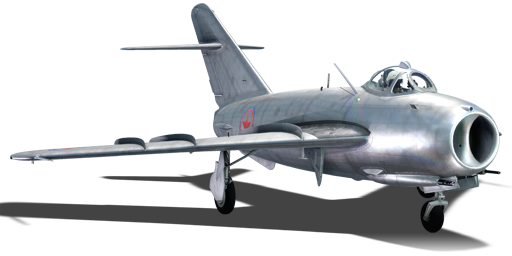
The Shenyang F-5 represents J-5s sent as military aid to the Korean People's Army Air Force from Mainland China. After Mainland China and the Soviet Union signed aiding treaties for the construction of Chinese's aviation industry in 1951, Factory 112 (State Songling Machinery Factory; now Shenyang Aircraft Corporation) was selected to be the factory to introduce the MiG-17F to Mainland China in view of the already obsolete performance of MiG-15bis. By November 1953, the license was issued to the factory. Before the deadline of National Day 1956, the first Chinese-assembled jet, J-5 (aircraft no. 中0101) made its maiden flight on July 19 and soon passed state certification in September 9, with 4 of them joining the PLAAF 10 days later. As one of the frontline jet fighters, the J-5 scored numerous victories against ROCAF and USAF while losing some of them during aerial combat, including the first victim of the AIM-9B. Some of these jets were also aided to Chinese allies of the time who also scored some victories against their enemies, especially by the North Vietnamese forces.
It was introduced as a premium pack in Update 1.91 "Night Vision" and was removed from the store after the 9th Anniversary Sale. It later returned for purchase in-game with Golden Eagles  during the 2022 "Lunar New Year" event.
As an improved variant of MiG-17F with two PL-2 missiles, thanks to its design, devastating autocannons and powerful, afterburning VK-1F (WP-5) jet engine, players can still utilize the tactics used on previous MiG jets and get to grips with the F-5 rather quickly; while it can handle most subsonic jets it might face, do beware of early supersonic jets: with proper tactics employed, hitting them when they have depleted their energy is always a good option.
General info
.png)
Flight performance
The MiG-17 was the solution to upgrading the MiG-15 and naturally with it being a successful fighter which was mass-produced, variants eventually became available for other nations to purchase. China was one of the countries which sought to acquire the later versions of the MiG-17 which utilized the VK-1F style afterburning engines. With its sleek frame, swept-back wings and tailplane, the F-5 though a bit heavier than the typical MiG-17 is a powerhouse in the sky. Compared to many other aircraft, using the afterburner will allow the F-5 to outclimb many of its contemporaries including the F-86 variants. Many pilots who hope to catch an F-5 in a climb will be disappointed when they stall out only to see the F-5 dropping in on them from above for an easy shot.
Thanks to the new engine, its sustained turn rate was improved by ~10% and can reach 19 deg/s when keeping the speed in horizontal turns close to 500 km/h which is more than enough to outturn in two circle fights most of subsonic or transonic jets like the CL-13, F-86 or J29F.
Though not built for instantaneous turns, at the top of a climbing arc, the F-5 can make a relatively quick reversal as they nose over and begin to descend, pulling back on the throttle, extending flaps and air brakes, the F-5 can set themselves up for a shot at a stalled out fighter or can manoeuvre to end up as the hunter in chase of its prey.
When diving in this fighter, it is crucial to watch the aircraft's speed, as it is possible to go slightly supersonic and at that point the control stiffening becomes excessive, making it extremely difficult to execute any finite movements.
With this fighter sporting an afterburner, it is essential to either watch the fuel level or take more into battle. The afterburner will consume fuel much faster than the aircraft without it. One advantage of this fighter as it consumes its fuel is that the plane becomes lighter and can eke out a bit more speed.
As an air-to-air fighter, it is possible to include two PL-2 air-to-air missiles in conjunction with the guns, or you can eliminate the missiles and entirely rely on the 37 mm and 2 x 23 mm autocannons. The gun placement on the underside of the fuselage is ideal for not needing to worry about convergence; however, the pilot will need to compensate for the different drop rates of the 37 and 23 mm cannons to ensure both will impact the enemy fighter without one or the other over-shooting or under-shooting.
| Characteristics | Max Speed (km/h at 2,000 m) |
Max altitude (metres) |
Turn time (seconds) |
Rate of climb (metres/second) |
Take-off run (metres) | |||
|---|---|---|---|---|---|---|---|---|
| AB | RB | AB | RB | AB | RB | |||
| Stock | 1,101 | 1,094 | 21.8 | 23.0 | 39.1 | 36.1 | 475 | |
| Upgraded | 1,126 | 1,114 | 21.2 | 21.5 | 61.9 | 50.0 | ||
Details
| Features | |||||
|---|---|---|---|---|---|
| Combat flaps | Take-off flaps | Landing flaps | Air brakes | Arrestor gear | Drogue chute |
| X | ✓ | ✓ | ✓ | X | X |
| Limits | ||||||
|---|---|---|---|---|---|---|
| Wings (km/h) | Gear (km/h) | Flaps (km/h) | Max Static G | |||
| Combat | Take-off | Landing | + | - | ||
| 1,150 | - | 598 | 450 | ~12 | ~5 | |
| Optimal velocities (km/h) | |||
|---|---|---|---|
| Ailerons | Rudder | Elevators | Radiator |
| < 600 | < 700 | < 750 | - |
Engine performance
| Engine | Aircraft mass | |||||
|---|---|---|---|---|---|---|
| Engine name | Number | Basic mass | Wing loading (full fuel) | |||
| Shenyang Liming WP-5 | 1 | 4,112 kg | 234 kg/m2 | |||
| Engine characteristics | Mass with fuel (no weapons load) | Max Takeoff Weight | ||||
| Weight (each) | Type | 9m fuel | 20m fuel | 30m fuel | ||
| 892 kg | Afterburning centrifugal-flow turbojet | 4,464 kg | 4,888 kg | 5,284 kg | 5,485 kg | |
| Maximum engine thrust @ 0 m (RB/SB) | Thrust to weight ratio @ 0 m (WEP) | |||||
| Condition | 100% | WEP | 9m fuel | 20m fuel | 30m fuel | MTOW |
| Stationary | 2,380 kgf | 2,932 kgf | 0.66 | 0.60 | 0.55 | 0.53 |
| Optimal | 2,380 kgf (0 km/h) |
2,932 kgf (0 km/h) |
0.66 | 0.60 | 0.55 | 0.53 |
Survivability and armour
- 60 mm Bulletproof glass - Front canopy windshield
- 16 mm Steel plate - Pilot's seat back
- 25 mm Steel plate - Pilot's headrest
- 10 mm Steel plate - in the nose of the aircraft before the cockpit
The F-5 has just enough armour protection to protect the pilot from machine-gun fire, smaller cannon fire and even some more substantial indirect cannon hits. Though not a guarantee of the pilot's survivability, the 10 mm steel plate in conjunction with the 60 mm bulletproof glass will aid in protecting the pilot in the event, he happens upon a bomber with defensive turrets or ends up in a head-on attack against another fighter. The 16 mm steel plates in the seat back and headrest will provide minimal protection as if ammunition fire from the rear penetrates that far, it is likely that the aircraft will already be experiencing catastrophic engine or structural failure.
Modifications and economy
Armaments
Offensive armament
The Shenyang F-5 is armed with:
- 1 x 37 mm Type 37-1 cannon, chin-mounted (40 rpg)
- 2 x 23 mm Type 23-1 cannons, chin-mounted (80 rpg = 160 total)
Just like Shenyang F5's old brother MiG-17, the different caliber armaments on both sides of the plane will balance each other out. Despite the F-5 holding the largest caliber among the its fighter peers, the 37 mm N-37D cannon needs experience to ace. Though the two "smaller" 23 mm NR-23 cannons are deadly and easier to master than the 37 mm N-37D. Due to the low ammo rounds per gun, all cannons are not of the "spray and pray" type. These guns rarely overheat, though this is mostly since the magazine will be empty after only five seconds of shooting. It is necessary to fire in bursts only if confidence is high enough that the shots can hit the targets. For ammo selection, one should use "Air targets" belt on all cannons since it contains the most high-explosive and incendiary shells that have great effect against air targets. Launching ground strikes using "Armored targets" belts is not a good option due to the slightly inaccurate and unpredictable trajectory.
Suspended armament
The Shenyang F-5 can be outfitted with the following ordnance:
- Without load
- 2 x 250 kg OFAB-250sv bombs (500 kg total)
- 2 x PL-2 missiles
Players also have access to PL-2 air-to-air missiles, which are the Chinese version of the Soviet K-13 AAM, which is similar to NATO AIM-9B Sidewinder AAM. The missiles are not great at this battle rating, but still usable. Players can choose not to carry them if they prefer using the gun to fight. To use these missiles, player have to spool up the tracker first. Spooling up the tracker will take 1 second. Just like AIM-9B or any other first generation AAM, PL-2 does not have any off-axis angle to lock the target. To increase the chance of hitting, aim at the opponent's tail while they are flying in a straight line and fire at a distance less than 2 km. Any manoeuvre the opponent performs will prevent the missile from hitting its target.
Players also have access to two 250 kg bombs. Two 250 kg bombs are not enough to bomb a base so they are only useful in the ground attack role in ground realistic battles. Keep aware of the tactical situation at hand to bring the most optimal weapons loadout to the battlefield.
Usage in battles
The Shenyang F-5 can be summarized as an energy-specialized variant of the Soviet MiG-17. The Shenyang F-5 is heavier, thus its instantaneous turn rate is moderately worse than the MiG-15s and the MiG-17s. However, when facing these aircraft, you can take advantage of your afterburner thanks to which this plane has better sustained turn rate at medium and high speed than both the MiG-17 and MiG-15. You should not turnfight these opponents or other planes like the Sabre series in most circumstances, instead, you should keep the fight strictly vertical. You have a far better climb rate, far more thrust than any MiG-15, -17 or CL-13B, therefore you can dictate the fight with relative ease. While you try to attain your altitude advantage, be aware of the Angle-Of-Attack (AoA) the MiG-15 and 17 can still pull, you most likely will have to dodge 1 or 2 firing solutions, then you will be out of harm's way, given you don't make a critical mistake. Turn this altitude advantage into an energy advantage to decide how and when to engage an enemy.
At high speed, the Sabre is much more manoeuvrable than you are. The Sabre will pull much harder, roll much better, and his guns are a lot easier to use. You must not try to roll around the Sabre's guns and reverse him often, because while this can work, the accessibility of his guns paired with his superior high-speed manoeuvrability leaves you at a very high chance of severe damage, or knock-out. If a Sabre is at your six-o'clock, and you two are at near equal speed, and obviously he's not extremely close: you should pitch up, turn your afterburner on, and climb. Not a single Sabre in-game can even rival your climb rate, thus, he will watch you takeoff, and there is nothing he can do besides disengaging from the pursuit.
Alternatively, if you are behind a Sabre and you cannot land shots, be aware. If he starts rolling, rapidly losing speed, and you start rapidly closing the distance, drop your throttle a tad, and pop your airbrakes. This "pre-airbraking" prevents you from overshooting, because once you start overshooting in the Shenyang F-5, you are in a lot of danger. Take your time with defensive Sabres, do not let them bait you into an overshoot. If the worst-case scenario arises and you overshoot, put yourself into a vertical corkscrew by utilizing your powerful thrust and manoeuvring energy retention to stall out your opponent. Be careful not to fly straight over their nose.
Uptiers in this plane are tough. Supersonic fighters outrun, and outclimb you, so while you are more manoeuvrable, you are relatively slow. Fighters such as the F-5C pull a lot of AoA at high speed. Your plane also compresses, so if you want to reliably dodge these aircraft, you need to actually slow yourself down to ~950 km/h, where you have optimal elevator, aileron, and rudder responsiveness. High-speed manoeuvrability is the only con of this plane, but you should only keep yourself slow when it's appropriate to do so.
Pros and cons
Pros:
- Excellent low-medium speed manoeuvrability, great stall characteristics
- Has a gyro gunsight that helps leading shots to some extent in simulator
- Access to anti-aircraft missiles
- Hard-hitting, concentrated armament
- Almost impossible to directly out-dogfight
Cons:
- Poor high-speed manoeuvrability, suffers from extreme elevator, rudder, and aileron compression
- Afterburner chews through fuel
- Guns are difficult to aim and have limited ammunition
- PL-2 missiles have very narrow locking arc
- Frontal-upward vision is entirely blocked out by the large cockpit frame, which disadvantages the pilot in simulator
- Unlike the original MiG-17, no rocket ordnance for ground attack
- Subsonic, easily outrun by many contemporaries
- No RWR or flares, highly vulnerable to incoming missiles
History
The Soviet MiG-17 was used quite extensively by the PLAAF in the early Cold War era. A production license for the more advanced MiG-17F model, which featured an afterburner, was obtained in the mid-1950s, and the result was the domestic Shenyang J-5, which made its first flight in 1956. In 1961, plans were obtained for the license production of the radar-equipped MiG-17PF model, but the ongoing Sino-Soviet split led to issues with the Chinese industry that delayed the first flight of the "J-5A" to 1964. At this point, the aircraft was rather obsolete, with the supersonic age being well underway, and production only continued for a few more years. Fewer J-5s were produced than the later J-6.
A unique trainer variant called the JJ-5 was produced by combining the cockpit of the MiG-15UTI with J-5 airframe elements and reduced armament; there was no trainer version of the MiG-17 since the Soviet Union saw no issue with using the MiG-15UTI for training new MiG-17 pilots.
The J-5 was exported under the designation of F-5 (not to be confused with the American F-5 Freedom Fighter) to numerous countries, including Albania, North Korea, Bangladesh, and Pakistan. The majority of these operators have retired the F-5 at the time of writing, with the lone exception being North Korea. J-5s remaining in the PLAAF inventory have been converted to target drones.
The vehicle represented in War Thunder is painted in the livery of the North Korean Air Force and has apparently been modified to use PL-2 air-to-air missiles.
Media
- Skins
- Videos
See also
- Aircraft of comparable role, configuration and era
External links
| Shenyang Aircraft Corporation (中航工业沈阳飞机工业(集团)有限公司) | |
|---|---|
| Jet Fighters | |
| MiG-15 | J-2* |
| MiG-17 | J-4* |
| MiG-19 | J-6A* |
| J-8 | J-8B · J-8F |
| Su-27 variants | J-11* · J-11A* |
| Export | Shenyang F-5* |
| *Licensed Note: "J-2" and "J-4" are not official designations | |
| See Also | Mikoyan-Gurevich Design Bureau |
| China jet aircraft | |
|---|---|
| Fighters | J-2 · J-4 · J-6A · J-7II · J-7D · J-7E · J-8B · J-8F · J-10A · J-11 · J-11A |
| Strike aircraft | Q-5 early · Q-5A · Q-5L · JH-7A |
| Bombers | H-5 |
| France | ␗Mirage 2000-5Ei |
| USA | ␗F-84G-21-RE · ␗F-84G-31-RE · ␗F-86F-30 · ␗F-86F-40 · ␗F-100A · ␗F-100F · ␗F-104A · ␗F-104G · ␗F-5A · ␗F-5E · ␗F-16A MLU |
| USSR | ␗MiG-9 · ␗MiG-9 (l) |
| North Korea | Shenyang F-5 |
| Pakistan | A-5C · JF-17 |
| China premium aircraft | |
|---|---|
| Fighters | ␗A6M2 · D.510C · ␗F-47N-25-RE · H-81A-2 · Hawk III · ␗Ki-45 hei/tei · ␗Ki-84 ko · ␗P-51C-11-NT |
| Jet fighters | Shenyang F-5 · J-7D |
| Strike aircraft | A-5C · ␗F-84G-31-RE |