Difference between revisions of "Hovet"
(Edits) |
(Updated description, history and armor table) |
||
| Line 6: | Line 6: | ||
== Description == | == Description == | ||
<!-- ''In the description, the first part should be about the history of the creation and combat usage of the vehicle, as well as its key features. In the second part, tell the reader about the ground vehicle in the game. Insert a screenshot of the vehicle, so that if the novice player does not remember the vehicle by name, he will immediately understand what kind of vehicle the article is talking about.'' --> | <!-- ''In the description, the first part should be about the history of the creation and combat usage of the vehicle, as well as its key features. In the second part, tell the reader about the ground vehicle in the game. Insert a screenshot of the vehicle, so that if the novice player does not remember the vehicle by name, he will immediately understand what kind of vehicle the article is talking about.'' --> | ||
| − | The '''{{Specs|name}}''' | + | The '''{{Specs|name}} (חובט, lit. batsman)''' represented the [[M163|M163 VADS]] in IDF service. According to the records from IDF, the vehicle joined Israeli Air Defense Command in 1975 as one of the new weapons for air defense alongside with MIM-72 Chaparral, which was introduced a year earlier; the Hovet, however, has to wait for 7 years until it earned its first victory against enemy target in 1982 Lebanese War and further served in IDF for more than 2 decades until the IADC was disbanded, leading to the decommission of Hovet and its modernized variant, '''[[Machbet]]''' which has been upgraded with TVD and 4 FIM-92 Stingers[[Machbet|.]] |
| + | |||
| + | Introduced in [[Update "Wind of Change"]] with the Israeli tech-tree and performs identically to its US Army cousin. Although the lack of search radar and its M113 chassis with minimal protection due to the aluminum alloy armor plates could cause problems when dueling with targets, the six-barrel M168 Vulcan can still strike fear to enemy aerial targets or vehicles with its high rate-of-fire and iconic rotating sound from the gun. | ||
== General info == | == General info == | ||
| Line 19: | Line 21: | ||
{| class="wikitable" | {| class="wikitable" | ||
| − | |||
! Armour !! Front (Slope angle) !! Sides !! Rear !! Roof | ! Armour !! Front (Slope angle) !! Sides !! Rear !! Roof | ||
|- | |- | ||
| − | | Hull || | + | | Hull || 38+6 mm (45°) ''Upper Glacis'' <br> 38 mm (26°) ''Lower Glacis'' <br> 29 mm (45°) ''Engine Maintenance Hatch'' || 44+6 mm ''Top'' <br> 32 mm ''Bottom'' || 38 mm || 38 mm |
| − | |||
| − | |||
|- | |- | ||
| − | | | + | |Turret || 17 mm ''Turret Front'' <br> 150 mm ''Gun Mantlet'' || 17 mm || 17 mm |
| + | ! | ||
|- | |- | ||
|} | |} | ||
| Line 117: | Line 117: | ||
== History == | == History == | ||
<!-- ''Describe the history of the creation and combat usage of the vehicle in more detail than in the introduction. If the historical reference turns out to be too long, take it to a separate article, taking a link to the article about the vehicle and adding a block "/History" (example: <nowiki>https://wiki.warthunder.com/(Vehicle-name)/History</nowiki>) and add a link to it here using the <code>main</code> template. Be sure to reference text and sources by using <code><nowiki><ref></ref></nowiki></code>, as well as adding them at the end of the article with <code><nowiki><references /></nowiki></code>. This section may also include the vehicle's dev blog entry (if applicable) and the in-game encyclopedia description (under <code><nowiki>=== In-game description ===</nowiki></code>, also if applicable).'' --> | <!-- ''Describe the history of the creation and combat usage of the vehicle in more detail than in the introduction. If the historical reference turns out to be too long, take it to a separate article, taking a link to the article about the vehicle and adding a block "/History" (example: <nowiki>https://wiki.warthunder.com/(Vehicle-name)/History</nowiki>) and add a link to it here using the <code>main</code> template. Be sure to reference text and sources by using <code><nowiki><ref></ref></nowiki></code>, as well as adding them at the end of the article with <code><nowiki><references /></nowiki></code>. This section may also include the vehicle's dev blog entry (if applicable) and the in-game encyclopedia description (under <code><nowiki>=== In-game description ===</nowiki></code>, also if applicable).'' --> | ||
| − | + | According to the description from Israel Air Force, the M163 VADS (which consists of 2 batteries per unit) joined the Israeli Air Defense Command in 1975; these batteries would usually deployed near the northern border of Israel where the Purple Line (post-1967 ceasefire line between Israel-Syria by the Golan Heights) sit during peaceful times; but as soon as there was any need for armed conflicts, the vehicles would redeploy with the ground forces. After 7 years of service, the system achieve 3 victories including the first victory of M163 VADS against jet aircrafts in 1982. On 1982/6/10, an battery commanded by Lt. Dobi Amitai was having conflicts with insurgents during the 1982 Lebanese War (Operation Peace for Galilee) at Douha near Beirut, where Sgt. Yoav Weinkert spotted a Syrian MiG-21; the other battery commanded by Roni Kovertovsky spotted the same jet from the eyes of gun director Tamir Mor. Both batteries, now at 4 vehicles, fired upon the jet while covering each other as they were taking fire from insurgents at the same time; 15 seconds later, the jet was shot down by the batteries.<ref>https://web.archive.org/web/20120310140629/http://www.iaf.org.il/239-18136-he/IAF.aspx?indx=1</ref> | |
| + | |||
| + | Some of the M163 were also converted into the Machbet (מחבט, lit. racquet) with upgrades including opto-electronic tracker, TVD and 4 FIM-92 Stingers mounted next to the turret. After the disbandment of the IADC in 2006, these vehicles were decommissioned. | ||
== Media == | == Media == | ||
Revision as of 15:31, 3 September 2023

Contents
Description
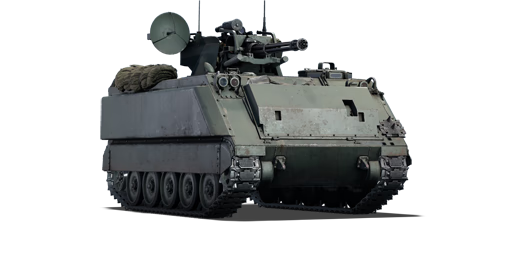
The Hovet (חובט, lit. batsman) represented the M163 VADS in IDF service. According to the records from IDF, the vehicle joined Israeli Air Defense Command in 1975 as one of the new weapons for air defense alongside with MIM-72 Chaparral, which was introduced a year earlier; the Hovet, however, has to wait for 7 years until it earned its first victory against enemy target in 1982 Lebanese War and further served in IDF for more than 2 decades until the IADC was disbanded, leading to the decommission of Hovet and its modernized variant, Machbet which has been upgraded with TVD and 4 FIM-92 Stingers.
Introduced in Update "Wind of Change" with the Israeli tech-tree and performs identically to its US Army cousin. Although the lack of search radar and its M113 chassis with minimal protection due to the aluminum alloy armor plates could cause problems when dueling with targets, the six-barrel M168 Vulcan can still strike fear to enemy aerial targets or vehicles with its high rate-of-fire and iconic rotating sound from the gun.
General info
Survivability and armour
Armour is thin enough and can be destroyed by 12.7 mm machine gun fire from the sides and rear, and by any cannon calibre from the front. The turret is partially open, leaving the crew vulnerable to enemy small arms fire. If attacked, the best bet for taking a hit and surviving is to point the engine towards the enemy and hope it absorbs the shot.
Armour type:
- Rolled homogeneous armour
| Armour | Front (Slope angle) | Sides | Rear | Roof |
|---|---|---|---|---|
| Hull | 38+6 mm (45°) Upper Glacis 38 mm (26°) Lower Glacis 29 mm (45°) Engine Maintenance Hatch |
44+6 mm Top 32 mm Bottom |
38 mm | 38 mm |
| Turret | 17 mm Turret Front 150 mm Gun Mantlet |
17 mm | 17 mm |
Notes:
Mobility
The Hovet suffers from a low power-to-weight ratio and low top speed. One of its upsides is the good acceleration
| Game Mode | Max Speed (km/h) | Weight (tons) | Engine power (horsepower) | Power-to-weight ratio (hp/ton) | |||
|---|---|---|---|---|---|---|---|
| Forward | Reverse | Stock | Upgraded | Stock | Upgraded | ||
| Arcade | Expression error: Unexpected * operator. | 301 | Expression error: Unexpected round operator. | __.__ | |||
| Realistic | 188 | Expression error: Unexpected round operator. | __.__ | ||||
Modifications and economy
Armaments
Main armament
| 20 mm M168 | Turret rotation speed (°/s) | Reloading rate (seconds) | ||||||||||||
|---|---|---|---|---|---|---|---|---|---|---|---|---|---|---|
| Mode | Capacity (Belt) | Fire rate | Vertical | Horizontal | Stabilizer | Stock | Upgraded | Full | Expert | Aced | Stock | Full | Expert | Aced |
| Arcade | 2,200 (1,100) | 3,000 | -5°/+80° | ±180° | N/A | 66.0 | 91.4 | 111.0 | 122.8 | 130.6 | 26.00 | 23.00 | 21.20 | 20.00 |
| Realistic | 44.6 | 52.5 | 63.8 | 70.5 | 75.0 | |||||||||
Ammunition
- Default: AP-I · HEI-T · API-T
- HEI: HEI-T · HEF-I · API-T · HEF-I
- AP-I: AP-I · API-T · HEF-I · API-T
| Penetration statistics | |||||||
|---|---|---|---|---|---|---|---|
| Ammunition | Penetration @ 0° Angle of Attack (mm) | ||||||
| 10 m | 100 m | 500 m | 1,000 m | 1,500 m | 2,000 m | ||
| AP-I | 40 | 36 | 22 | 12 | 6 | 3 | |
| API-T | 40 | 36 | 22 | 12 | 6 | 3 | |
| HEF-I | 5 | 5 | 3 | 2 | 2 | 2 | |
| HEI-T | 5 | 5 | 3 | 2 | 2 | 2 | |
| Shell details | ||||||||||||
|---|---|---|---|---|---|---|---|---|---|---|---|---|
| Ammunition | Velocity (m/s) |
Projectile mass (kg) |
Fuse delay (m) |
Fuse sensitivity (mm) |
Explosive mass (TNT equivalent) (g) |
Ricochet | ||||||
| 0% | 50% | 100% | ||||||||||
| AP-I | 1,030 | 0.1 | - | - | - | 47° | 56° | 65° | ||||
| API-T | 1,030 | 0.1 | - | - | - | 47° | 60° | 65° | ||||
| HEF-I | 1,030 | 0.1 | 0.1 | 0.1 | 17.12 | - | - | - | ||||
| HEI-T | 1,030 | 0.1 | 0.1 | 0.1 | 12 | 79° | 80° | 81° | ||||
Ammo racks
| Full ammo |
1st rack empty |
2nd rack empty |
3rd rack empty |
4th rack empty |
5th rack empty |
6th rack empty |
Visual discrepancy |
|---|---|---|---|---|---|---|---|
| 2 | __ (+__) | __ (+__) | __ (+__) | __ (+__) | __ (+__) | __ (+__) | __ |
Usage in battles
The Hovet has an amazing rate of fire with the M168 gun, thus it has amazing damage output. In an anti-aircraft role, it is best used as a point-defence SPAA, defending a group of allies/cap zone from air attack. Its range isn't as good as the M247, so it's best to keep in mind the approximate 1 km targeting zone of the Hovet.
The Hovet wields about 60 mm of penetration, which is enough to mortally wound/destroy many lightly-armoured vehicles such as the Leopard, AUBL, and Centauro. The high rate of fire also allows the Hovet a sort of CIWS (Close-In Weapon System) type of role, as it can easily spray in the direction of an incoming bomb, thus destroying it and saving nearby allies. This is especially easy against the infamous FAB-5000 bomb from the Soviet Pe-8, as the bomb is large and easy to track.
Pros and cons
Pros:
- Can be used as a last resort weapon to shoot down incoming bombs and rockets
- Cannot be easily killed by .50 cal MGs, meaning you are stronger against strafing aircraft
- High rate of fire
Cons:
- Long reload time
- The 20 mm shells lose velocity quickly, making it very difficult to attack fast planes past 2 km or light tanks past 1 km
- No passive radar search
- The gun overheats over quickly
- Low penetration
History
According to the description from Israel Air Force, the M163 VADS (which consists of 2 batteries per unit) joined the Israeli Air Defense Command in 1975; these batteries would usually deployed near the northern border of Israel where the Purple Line (post-1967 ceasefire line between Israel-Syria by the Golan Heights) sit during peaceful times; but as soon as there was any need for armed conflicts, the vehicles would redeploy with the ground forces. After 7 years of service, the system achieve 3 victories including the first victory of M163 VADS against jet aircrafts in 1982. On 1982/6/10, an battery commanded by Lt. Dobi Amitai was having conflicts with insurgents during the 1982 Lebanese War (Operation Peace for Galilee) at Douha near Beirut, where Sgt. Yoav Weinkert spotted a Syrian MiG-21; the other battery commanded by Roni Kovertovsky spotted the same jet from the eyes of gun director Tamir Mor. Both batteries, now at 4 vehicles, fired upon the jet while covering each other as they were taking fire from insurgents at the same time; 15 seconds later, the jet was shot down by the batteries.[1]
Some of the M163 were also converted into the Machbet (מחבט, lit. racquet) with upgrades including opto-electronic tracker, TVD and 4 FIM-92 Stingers mounted next to the turret. After the disbandment of the IADC in 2006, these vehicles were decommissioned.
Media
- Skins
See also
External links
Paste links to sources and external resources, such as:
- topic on the official game forum;
- other literature.
| Israel anti-aircraft vehicles | |
|---|---|
| Half-track | TCM-20 |
| M163 derivatives | Hovet · Machbet · Imp.Chaparral |
| Captured | ZSU-57-2 · ZSU-23-4 |