Difference between revisions of "J-4"
(Edits) |
(→Details) |
||
| Line 53: | Line 53: | ||
! Combat !! Take-off !! Landing !! + !! - | ! Combat !! Take-off !! Landing !! + !! - | ||
|- | |- | ||
| − | | {{Specs|destruction|body}} || {{Specs|destruction|gear}} || | + | | 1,150 <!-- {{Specs|destruction|body}} --> || {{Specs|destruction|gear}} || - || 598 || 450 || ~12 || ~5 |
|- | |- | ||
|} | |} | ||
| Line 63: | Line 63: | ||
! Ailerons !! Rudder !! Elevators !! Radiator | ! Ailerons !! Rudder !! Elevators !! Radiator | ||
|- | |- | ||
| − | | < 600 || < 700 || < 750 || | + | | < 600 || < 700 || < 750 || - |
|- | |- | ||
|} | |} | ||
| Line 94: | Line 94: | ||
! 8m fuel || 20m fuel || 29m fuel || MTOW | ! 8m fuel || 20m fuel || 29m fuel || MTOW | ||
|- | |- | ||
| − | | ''Stationary'' || 2,450 kgf || | + | | ''Stationary'' || 2,450 kgf || - |
| 0.57 || 0.52 || 0.48 || 0.45 | | 0.57 || 0.52 || 0.48 || 0.45 | ||
|- | |- | ||
| − | | ''Optimal'' || 2,450 kgf<br>(0 km/h) || | + | | ''Optimal'' || 2,450 kgf<br>(0 km/h) || - |
| 0.57 || 0.52 || 0.48 || 0.45 | | 0.57 || 0.52 || 0.48 || 0.45 | ||
|- | |- | ||
Revision as of 15:43, 20 May 2023

Contents
Description
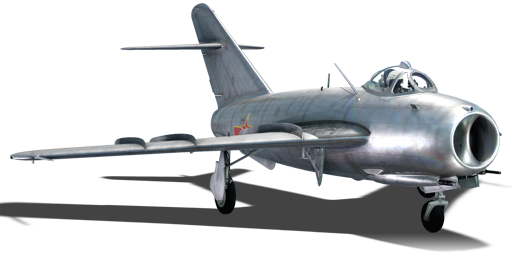
The J-4 is a rank Chinese jet fighter with a battle rating of (AB), (RB), and (SB). It was introduced in Update 1.91 "Night Vision". It is a Chinese version of the MiG-17 and performs identically to it.
General info
Flight performance
| Characteristics | Max Speed (km/h at 2,000 m) |
Max altitude (metres) |
Turn time (seconds) |
Rate of climb (metres/second) |
Take-off run (metres) | |||
|---|---|---|---|---|---|---|---|---|
| AB | RB | AB | RB | AB | RB | |||
| Stock | 1,091 | 1,061 | 22.2 | 23.2 | 41.2 | 39.1 | 475 | |
| Upgraded | 1,128 | 1,114 | 21.2 | 21.5 | 59.9 | 50.0 | ||
Details
| Features | |||||
|---|---|---|---|---|---|
| Combat flaps | Take-off flaps | Landing flaps | Air brakes | Arrestor gear | Drogue chute |
| X | ✓ | ✓ | ✓ | X | X |
| Limits | ||||||
|---|---|---|---|---|---|---|
| Wings (km/h) | Gear (km/h) | Flaps (km/h) | Max Static G | |||
| Combat | Take-off | Landing | + | - | ||
| 1,150 | - | 598 | 450 | ~12 | ~5 | |
| Optimal velocities (km/h) | |||
|---|---|---|---|
| Ailerons | Rudder | Elevators | Radiator |
| < 600 | < 700 | < 750 | - |
Engine performance
| Engine | Aircraft mass | |||||
|---|---|---|---|---|---|---|
| Engine name | Number | Basic mass | Wing loading (full fuel) | |||
| Klimov VK-1 | 1 | 3,958 kg | 227 kg/m2 | |||
| Engine characteristics | Mass with fuel (no weapons load) | Max Takeoff Weight | ||||
| Weight (each) | Type | 8m fuel | 20m fuel | 29m fuel | ||
| 872 kg | Centrifugal-flow turbojet | 4,310 kg | 4,755 kg | 5,130 kg | 5,485 kg | |
| Maximum engine thrust @ 0 m (RB/SB) | Thrust to weight ratio @ 0 m (100%) | |||||
| Condition | 100% | WEP | 8m fuel | 20m fuel | 29m fuel | MTOW |
| Stationary | 2,450 kgf | - | 0.57 | 0.52 | 0.48 | 0.45 |
| Optimal | 2,450 kgf (0 km/h) |
- | 0.57 | 0.52 | 0.48 | 0.45 |
Survivability and armour
- 60 mm Bulletproof glass in cockpit front.
- 16 mm Steel plates behind the pilot.
- 10 mm Steel plate in the nose.
Modifications and economy
Armaments
Offensive armament
The J-4 is armed with:
- 1 x 37 mm N-37D cannon, chin-mounted (40 rpg)
- 2 x 23 mm NR-23 cannons, chin-mounted (80 rpg = 160 total)
Suspended armament
The J-4 can be outfitted with the following ordnance:
- Without load
- 2 x 250 kg OFAB-250sv bombs (500 kg total)
- 16 x S-5K rockets
- 16 x S-5M rockets
- 2 x S-21 rockets
Usage in battles
The newly gained top speed performance and manoeuvrability come at a hefty price. Turn rate and low speed flexibility are reduced, due the stronger swept wing design and weight gain.
Acceleration also takes a hit, especially on take-off the predecessor will rush ahead.
As some positive characteristics traits of the MiG-15 vanish, some negative aspects also vanish. The newly designed tail enables far better control close to Mach 0.8 (it still lacks a flying tail though) and the roll rate also significantly improved. Manual limitation set the airframe at positive 8G, with the increased control the likelihood of over stressing your airframe is easy and a steady hand required in evasive manoeuvres.
Pros and cons
Pros:
- Incredibly fast in a dive.
- Excellent climb speed, almost same as the J-2
- Very good manoeuvrability at low to medium speeds, also better manoeuvrability than its predecessor at high speed
- Excellent energy retention, but if you turn too hard, expect to lose a few hundred km/h
- Can safely reach a speed of 1,150 km/h when diving
- Unless rolling and pulling up at the same time, it's hard to break your wings in turn
Cons:
- Roll rate is not very good
- Guns are hard to aim and lead due to their relatively low muzzle velocity; small ammo capacity
- Different trajectory performances between 23 mm and 37 mm; requires experience and practice to use the weapons
- Guns tend to spark a lot (the N-37 in particular), especially with stock belts
- Poor acceleration between 800 - 1,100 km/h
- Doesn't do well in uptiers due to lack of air-to-air missiles, afterburner and radar
- Engine easily overheats, throttle management necessary
- Poor forward visibility in simulator, as a large canopy frame and the gunsight block the top and bottom
History
The usage of the designation J-4 is unclear, though most western observers claim it was applied to either the MiG-15 or MiG-17. One theory suggested that J-4 was the Chinese designation of the MiG-15bis, though this was later debunked when it was found that the J-2 was in fact a 15bis model. The most likely theory (and the one followed in-game) is that the designation was applied to imported Soviet-built MiG-17As, while license-built MiG-17Fs were designated Shenyang J-5 (F-5).
The MiG-17 was purchased and used by the PLAAF during the early Cold War era. It saw service alongside the MiG-15 during the Second Taiwan Strait Crisis, fighting against the ROCAF's F-86 Sabres. The two air forces were matched fairly evenly in terms of aircraft, perhaps with performance advantage going to the MiG-17s over the Sabres, but during the course of the conflict the Sabres were upgraded to use the AIM-9 Sidewinder air-to-air missile. This new weapon was used successfully to shoot down numerous Communist aircraft, starting its first combat experience on a good note. However, in late September 1958, a dud Sidewinder lodged itself in a MiG-17, which returned to base. The missile was successfully removed and eventually sent to the Soviet Union for reverse engineering. The result of this would be the very similar Vympel K-13 missile, entering service as the R-3S in 1962. The PLAAF would also license produce the K-13 as the PL-2 some years later, bringing the Sidewinder into service on the other side of the Taiwan Strait.
Information is sparse on the fate of the MiG-17 afterwards. They were most likely supplanted by the domestically produced Shenyang J-5 version and eventually phased out of service upon the introduction of sufficient quantities of the superior MiG-19/J-6 and J-7.
Media
- Skins
See also
- Related development
External links
| Shenyang Aircraft Corporation (中航工业沈阳飞机工业(集团)有限公司) | |
|---|---|
| Jet Fighters | |
| MiG-15 | J-2* |
| MiG-17 | J-4* |
| MiG-19 | J-6A* |
| J-8 | J-8B · J-8F |
| Su-27 variants | J-11* · J-11A* |
| Export | Shenyang F-5* |
| *Licensed Note: "J-2" and "J-4" are not official designations | |
| See Also | Mikoyan-Gurevich Design Bureau |
| China jet aircraft | |
|---|---|
| Fighters | J-2 · J-4 · J-6A · J-7II · J-7D · J-7E · J-8B · J-8F · J-10A · J-11 · J-11A |
| Strike aircraft | Q-5 early · Q-5A · Q-5L · JH-7A |
| Bombers | H-5 |
| France | ␗Mirage 2000-5Ei |
| USA | ␗F-84G-21-RE · ␗F-84G-31-RE · ␗F-86F-30 · ␗F-86F-40 · ␗F-100A · ␗F-100F · ␗F-104A · ␗F-104G · ␗F-5A · ␗F-5E · ␗F-16A MLU |
| USSR | ␗MiG-9 · ␗MiG-9 (l) |
| North Korea | Shenyang F-5 |
| Pakistan | A-5C · JF-17 |