Difference between pages "USS Phelps" and "SGB Grey Goose"
(→Secondary armament) |
(→Ammunition: Converted to transclusion) |
||
| Line 1: | Line 1: | ||
{{Specs-Card | {{Specs-Card | ||
| − | |code= | + | |code=uk_sgb_309 |
|images={{Specs-Card-Image|GarageImage_{{PAGENAME}}.jpg}} | |images={{Specs-Card-Image|GarageImage_{{PAGENAME}}.jpg}} | ||
| − | |market= | + | |market=SGB (S309) (Britain) |
}} | }} | ||
== Description == | == Description == | ||
<!-- ''In the first part of the description, cover the history of the ship's creation and military application. In the second part, tell the reader about using this ship in the game. Add a screenshot: if a beginner player has a hard time remembering vehicles by name, a picture will help them identify the ship in question.'' --> | <!-- ''In the first part of the description, cover the history of the ship's creation and military application. In the second part, tell the reader about using this ship in the game. Add a screenshot: if a beginner player has a hard time remembering vehicles by name, a picture will help them identify the ship in question.'' --> | ||
| − | The '''{{Specs|name}}''' is a premium gift rank {{Specs|rank}} | + | The '''{{Specs|name}}''' is a premium gift rank {{Specs|rank}} British motor gun boat {{Battle-rating}}. It was introduced during [[Update 1.97 "Viking Fury"]] as a reward for the [[wt:en/news/6669-special-space-race-en|"Space Race" event]]. |
== General info == | == General info == | ||
=== Survivability and armour === | === Survivability and armour === | ||
| − | {{Specs-Fleet-Armour}}<!-- Talk about the vehicle's armour. Note the most well-defended and most vulnerable zones, e.g. the ammo magazine. Evaluate the composition of components and assemblies responsible for movement and manoeuvrability. Evaluate the survivability of the primary and secondary armaments separately. Don't forget to mention the size of the crew, which plays an important role in fleet mechanics. Save tips on preserving survivability for the "Usage in battles" section. If necessary, use a graphical template to show the most well-protected or most vulnerable points in the armour. --> | + | {{Specs-Fleet-Armour}} |
| − | + | <!-- ''Talk about the vehicle's armour. Note the most well-defended and most vulnerable zones, e.g. the ammo magazine. Evaluate the composition of components and assemblies responsible for movement and manoeuvrability. Evaluate the survivability of the primary and secondary armaments separately. Don't forget to mention the size of the crew, which plays an important role in fleet mechanics. Save tips on preserving survivability for the "Usage in battles" section. If necessary, use a graphical template to show the most well-protected or most vulnerable points in the armour.'' --> | |
| + | |||
| + | The Grey Goose has a 6 mm thick steel hull and 4 mm thick steel superstructure, with barely any armour whatsoever. It has 12.7 mm antifragmentation armour on the front guns and 8 mm antifragmentation armour on the 76 mm gun on the back, this combined with the profile of the guns result in the armaments only getting hit and disabled rarely. It also has 19 mm thick antifragmentation armour located on both sides of the boat near the center, where the engine is located. This makes the engine protected against most low calibre weapons on its tier, and it can usually be only penetrated by higher calibre AP rounds. This armour however does not extend far enough to protect any of the ammo storages on the ship, and if the front is under heavy fire, it will often result in the detonation of the quite large ammunition storage. The ship crew consists of only 34 people, making it the second most common cause of destruction. | ||
=== Mobility === | === Mobility === | ||
| − | {{Specs-Fleet-Mobility}}<!-- Write about the ship's mobility. Evaluate its power and manoeuvrability, rudder rerouting speed, stopping speed at full tilt, with its maximum forward and reverse speed. --> | + | {{Specs-Fleet-Mobility}} |
| − | + | <!-- ''Write about the ship's mobility. Evaluate its power and manoeuvrability, rudder rerouting speed, stopping speed at full tilt, with its maximum forward and reverse speed.'' --> | |
| + | |||
| + | The ship has a maximum speed of 87 km/h in AB and 65 km/h in RB. Acceleration and deceleration is poor, but turning rate is excellent at high speeds compared to other ships of its size, comparable to PT boats, which it can mostly keep up with. | ||
| + | |||
| + | Displacement is 255 tons. | ||
=== Modifications and economy === | === Modifications and economy === | ||
| Line 26: | Line 32: | ||
{{Specs-Fleet-Primary}} | {{Specs-Fleet-Primary}} | ||
<!-- ''Provide information about the characteristics of the primary armament. Evaluate their efficacy in battle based on their reload speed, ballistics and the capacity of their shells. Add a link to the main article about the weapon: <code><nowiki>{{main|Weapon name (calibre)}}</nowiki></code>. Broadly describe the ammunition available for the primary armament, and provide recommendations on how to use it and which ammunition to choose.'' --> | <!-- ''Provide information about the characteristics of the primary armament. Evaluate their efficacy in battle based on their reload speed, ballistics and the capacity of their shells. Add a link to the main article about the weapon: <code><nowiki>{{main|Weapon name (calibre)}}</nowiki></code>. Broadly describe the ammunition available for the primary armament, and provide recommendations on how to use it and which ammunition to choose.'' --> | ||
| − | + | {{main|2pdr QF Mk.IIc (40 mm)|20 mm/70 Oerlikon Mk.II (20 mm)}} | |
| − | + | ||
| + | The main guns are located on the front of the ship, a [[2pdr QF Mk.IIc (40 mm)]] automatic cannon and a [[20 mm/70 Oerlikon Mark 24 (20 mm)|20 mm/70 Oerlikon Mk.II (20 mm) autocannon]]. Both have 56 ammo in a clip, but the 20 mm fires considerably faster, usually emptying multiple seconds before the 40 mm. This can prove to be useful, as you can sustain fire with at least one of the guns at all times. They have 2240 and 1800 maximum total ammunition respectively, providing a generous pool for long engagements. The turrets can rotate almost all the way to the back, but the 20 mm blocks the 40 mm from firing directly to the front, so the ship needs to be angled slightly off target if both guns need to be fired on it. They are fit for close to medium range engagements, but quickly fall off at long ranges. | ||
| + | |||
| + | All three belts contain the same AP-T (Armour-piercing tracer shell) and HEF (High-explosive fragmentation shell) ammunition, only in different ratios. This makes all belts viable, the selection should be only based on speculation of opponents or preferred targets, and eliminate the need to switch belt type mid-battle. | ||
| − | + | * '''Universal:''' {{Annotation|HEF|High-explosive fragmentation}}{{-}}{{Annotation|AP-T|Armour-piercing tracer}}{{-}}{{Annotation|HEF|High-explosive fragmentation}}{{-}}{{Annotation|AP-T|Armour-piercing tracer}} | |
| + | * '''40 mm HE:''' {{Annotation|HEF|High-explosive fragmentation}}{{-}}{{Annotation|HEF|High-explosive fragmentation}}{{-}}{{Annotation|HEF|High-explosive fragmentation}}{{-}}{{Annotation|AP-T|Armour-piercing tracer}} | ||
| + | * '''40 mm AP:''' {{Annotation|AP-T|Armour-piercing tracer}}{{-}}{{Annotation|AP-T|Armour-piercing tracer}}{{-}}{{Annotation|AP-T|Armour-piercing tracer}}{{-}}{{Annotation|HEF|High-explosive fragmentation}} | ||
| − | + | {{:2pdr QF Mk.IIc (40 mm)/Ammunition|HEF, AP-T}} | |
| − | { | ||
| − | |||
| − | |||
| − | |||
| − | |||
| − | |||
| − | |||
| − | |||
| − | |||
| − | |||
| − | |||
| − | |||
| − | |||
| − | |||
| − | |||
| − | |||
| − | |||
| − | |||
| − | |||
| − | |||
| − | |||
| − | |||
| − | |||
| − | |||
| − | |||
| − | |||
| − | |||
| − | |||
| − | |||
| − | |||
| − | |||
| − | |||
| − | |||
| − | |||
| − | |||
| − | |||
| − | |||
| − | |||
| − | |||
| − | |||
| − | |||
| − | |||
| − | |||
| − | |||
| − | |||
| − | |||
| − | |||
| − | |||
| − | |||
| − | |||
| − | |||
| − | |||
| − | |||
| − | |||
| − | |||
| − | |||
| − | |||
| − | |||
=== Secondary armament === | === Secondary armament === | ||
{{Specs-Fleet-Secondary}} | {{Specs-Fleet-Secondary}} | ||
<!-- ''Some ships are fitted with weapons of various calibres. Secondary armaments are defined as weapons chosen with the control <code>Select secondary weapon</code>. Evaluate the secondary armaments and give advice on how to use them. Describe the ammunition available for the secondary armament. Provide recommendations on how to use them and which ammunition to choose. Remember that any anti-air armament, even heavy calibre weapons, belong in the next section. If there is no secondary armament, remove this section.'' --> | <!-- ''Some ships are fitted with weapons of various calibres. Secondary armaments are defined as weapons chosen with the control <code>Select secondary weapon</code>. Evaluate the secondary armaments and give advice on how to use them. Describe the ammunition available for the secondary armament. Provide recommendations on how to use them and which ammunition to choose. Remember that any anti-air armament, even heavy calibre weapons, belong in the next section. If there is no secondary armament, remove this section.'' --> | ||
| − | {{main| | + | {{main|76 mm/45 QF 3in 20cwt (76 mm)}} |
| + | |||
| + | The ship is armed with a 76 mm/45 QF 3in 20cwt cannon, which has 150 total ammunition. | ||
| − | + | The HE shell should be used against other ships, but it only has 6 mm of penetration, so it is only effective against lightly-armoured targets. The shrapnel round is effective against small boats, and thanks to its unique quality, it can also be used as a crude variable time fused AA cannon. Due to the relatively low muzzle velocity and low calibre compared to proper flak cannons, it will usually only deter enemy aircraft, with actual kills with it being rare. If both sea and air targets are set to be engaged, this turret will prefer air targets, often suppressing them through the course of the match. | |
| − | + | ||
| − | + | {{:76 mm/45 QF 3in 20cwt (76 mm)/Ammunition|76 mm HE shell, 76 mm Mk.I shrapnel}} | |
| − | |||
| − | |||
| − | |||
| − | |||
| − | |||
| − | |||
| − | |||
| − | |||
| − | |||
| − | |||
| − | |||
| − | |||
| − | { | ||
| − | |||
| − | |||
| − | |||
| − | |||
| − | |||
| − | |||
| − | |||
| − | |||
| − | |||
| − | |||
| − | |||
| − | |||
| − | |||
| − | |||
| − | |||
| − | |||
| − | |||
=== Anti-aircraft armament === | === Anti-aircraft armament === | ||
{{Specs-Fleet-AA}} | {{Specs-Fleet-AA}} | ||
<!-- ''An important part of the ship's armament responsible for air defence. Anti-aircraft armament is defined by the weapon chosen with the control <code>Select anti-aircraft weapons</code>. Talk about the ship's anti-air cannons and machine guns, the number of guns and their positions, their effective range, and about their overall effectiveness – including against surface targets. If there are no anti-aircraft armaments, remove this section.'' --> | <!-- ''An important part of the ship's armament responsible for air defence. Anti-aircraft armament is defined by the weapon chosen with the control <code>Select anti-aircraft weapons</code>. Talk about the ship's anti-air cannons and machine guns, the number of guns and their positions, their effective range, and about their overall effectiveness – including against surface targets. If there are no anti-aircraft armaments, remove this section.'' --> | ||
| − | {{main| | + | {{main|Vickers Mk.V (12.7 mm)}} |
| − | + | Two turrets outfitted each with two [[Vickers Mk.V (12.7 mm)|12.7 mm Vickers Mk.V]] machine guns can be found on both sides of the boat, and they have 8,000 total rounds. They can aim to the sides of the ship, and all the way up, and thanks to the high rate of fire, typically kills smaller close flying aircraft and smaller PT-boats, but becoming ineffective at medium-long ranges. | |
=== Additional armament === | === Additional armament === | ||
{{Specs-Fleet-Additional}} | {{Specs-Fleet-Additional}} | ||
<!-- ''Describe the available additional armaments of the ship: depth charges, mines, torpedoes. Talk about their positions, available ammunition and launch features such as dead zones of torpedoes. If there is no additional armament, remove this section.'' --> | <!-- ''Describe the available additional armaments of the ship: depth charges, mines, torpedoes. Talk about their positions, available ammunition and launch features such as dead zones of torpedoes. If there is no additional armament, remove this section.'' --> | ||
| − | + | {{main|Mk.VIII (533 mm)|Type M Mark I mine}} | |
| − | {{main|Mk. | ||
| − | The | + | The ship is outfitted with 2 x [[Mk.VIII (533 mm)]] torpedo launcher tubes, pointing forward, but angled away considerably. This angle matches the usual engagement angle. The destructive power combined with high mobility can be deadly against larger craft, which would resist the smaller armaments on the ship otherwise. |
| + | |||
| + | The ship can be equipped with 4 x [[Type M Mark I mine]]s, 2 on each side, in the back. They are dropped individually, starting with the 2 on the left and then on the right. They can destroy almost any vessel on the same battle rating, mostly if deployed along high traffic, narrow routes, or near capture points. | ||
== Usage in battles == | == Usage in battles == | ||
| − | <!-- Describe the technique of using this ship, the characteristics of her use in a team and tips on strategy. Abstain from writing an entire guide – don't try to provide a single point of view, but give the reader food for thought. Talk about the most dangerous opponents for this vehicle and provide recommendations on fighting them. If necessary, note the specifics of playing with this vehicle in various modes (AB, RB, SB). | + | <!-- ''Describe the technique of using this ship, the characteristics of her use in a team and tips on strategy. Abstain from writing an entire guide – don't try to provide a single point of view, but give the reader food for thought. Talk about the most dangerous opponents for this vehicle and provide recommendations on fighting them. If necessary, note the specifics of playing with this vehicle in various modes (AB, RB, SB).'' --> |
| − | |||
| − | |||
| − | |||
| − | |||
| − | |||
| − | + | The Grey Goose is best played as a PT-boat hunter, but remains usable up to ships of the same size. The rapid-firing guns allow for quick adjustments, making it adaptable to quick range or speed changes of the target. The amount and type of armaments on the ship allow it to take up the position of an AA-ship for a while, if need be. It is best to avoid larger ships and long engagement ranges, as any hit from a larger calibre can destroy it, and the majority of the guns fall off at great distances. | |
=== Pros and cons === | === Pros and cons === | ||
| − | <!-- Summarise and briefly evaluate the vehicle in terms of its characteristics and combat effectiveness. Mark its pros and cons in the bulleted list. Try not to use more than 6 points for each of the characteristics. Avoid using categorical definitions such as "bad", "good" and the like - use substitutions with softer forms such as "inadequate" and "effective". --> | + | <!-- ''Summarise and briefly evaluate the vehicle in terms of its characteristics and combat effectiveness. Mark its pros and cons in the bulleted list. Try not to use more than 6 points for each of the characteristics. Avoid using categorical definitions such as "bad", "good" and the like - use substitutions with softer forms such as "inadequate" and "effective".'' --> |
'''Pros:''' | '''Pros:''' | ||
| − | * | + | * High speed |
| − | ** | + | * Manoeuvrability |
| − | * | + | * Rapid-firing, accurate armaments |
| − | + | * Option for a "primitive" flak cannon | |
| − | |||
'''Cons:''' | '''Cons:''' | ||
| − | * | + | * Poor acceleration and deceleration |
| − | * | + | * No armour around some components and ammunition |
| − | * | + | * Short effective distance |
| − | * | + | * Weapons not fit to fight larger ships |
== History == | == History == | ||
| − | <!-- Describe the history of the creation and combat usage of the ship in more detail than in the introduction. If the historical reference turns out to be too long, take it to a separate article, taking a link to the article about the ship and adding a block "/History" (example: https://wiki.warthunder.com/(Ship-name)/History) and add a link to it here using the main template. Be sure to reference text and sources by using <ref></ref>, as well as adding them at the end of the article with <references />. This section may also include the ship's dev blog entry (if applicable) and the in-game encyclopedia description (under === In-game description === | + | <!-- ''Describe the history of the creation and combat usage of the ship in more detail than in the introduction. If the historical reference turns out to be too long, take it to a separate article, taking a link to the article about the ship and adding a block "/History" (example: <nowiki>https://wiki.warthunder.com/(Ship-name)/History</nowiki>) and add a link to it here using the <code>main</code> template. Be sure to reference text and sources by using <code><nowiki><ref></ref></nowiki></code>, as well as adding them at the end of the article with <code><nowiki><references /></nowiki></code>. This section may also include the ship's dev blog entry (if applicable) and the in-game encyclopedia description (under <code><nowiki>=== In-game description ===</nowiki></code>, also if applicable).'' --> |
| − | |||
| − | |||
| − | |||
| − | |||
| − | |||
| − | |||
| − | |||
| − | |||
| − | |||
| − | '' | ||
| − | |||
| − | |||
| − | |||
| − | |||
| − | + | The SGB series was designed due to the need of a hybrid of a motor gun boat and a motor torpedo boat by the Royal Navy. They were the only Coastal Forces ships to be made of steel. The Royal Navy originally wanted 52 of them, but only ordered 9. The series was marked SGB 1 to 9. 2 of them were destroyed during production, and only 6 of them survived the war. SGB9 was used as a trial vessel until 1956 by Vospers. The Grey Goose was sold in 1957, and is currently in Hoo St Werburgh, used as a houseboat. | |
| − | |||
| − | |||
| − | The | ||
== Media == | == Media == | ||
| Line 199: | Line 102: | ||
;Skins | ;Skins | ||
| − | |||
| − | + | * [https://live.warthunder.com/feed/camouflages/?vehicle=uk_sgb_309 Skins and camouflages for the {{PAGENAME}} from live.warthunder.com.] | |
| − | |||
| − | |||
| − | |||
| − | |||
| − | |||
| − | |||
| − | |||
| − | |||
== See also == | == See also == | ||
| Line 216: | Line 110: | ||
* ''links to approximate analogues of other nations and research trees.'' --> | * ''links to approximate analogues of other nations and research trees.'' --> | ||
| − | * [[ | + | ;Related development |
| + | |||
| + | * [[SGB (S304)]] | ||
== External links == | == External links == | ||
| Line 223: | Line 119: | ||
* ''other literature.'' --> | * ''other literature.'' --> | ||
| − | * [[ | + | * [[wikipedia:Steam_Gun_Boat|[Wikipedia] Steam Gun Boat]] |
| − | |||
| − | |||
| − | |||
| − | |||
| − | |||
| − | |||
| − | |||
| − | |||
| − | |||
| − | {{ShipManufacturer | + | {{ShipManufacturer J. Samuel White}} |
| − | {{ | + | {{Britain boats}} |
| − | {{ | + | {{Britain premium ships}} |
Latest revision as of 18:26, 1 March 2023

Contents
Description
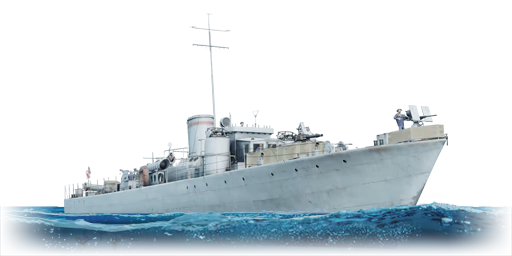
The SGB Grey Goose (S309) is a premium gift rank British motor gun boat with a battle rating of (AB), (RB), and (SB). It was introduced during Update 1.97 "Viking Fury" as a reward for the "Space Race" event.
General info
Survivability and armour
The Grey Goose has a 6 mm thick steel hull and 4 mm thick steel superstructure, with barely any armour whatsoever. It has 12.7 mm antifragmentation armour on the front guns and 8 mm antifragmentation armour on the 76 mm gun on the back, this combined with the profile of the guns result in the armaments only getting hit and disabled rarely. It also has 19 mm thick antifragmentation armour located on both sides of the boat near the center, where the engine is located. This makes the engine protected against most low calibre weapons on its tier, and it can usually be only penetrated by higher calibre AP rounds. This armour however does not extend far enough to protect any of the ammo storages on the ship, and if the front is under heavy fire, it will often result in the detonation of the quite large ammunition storage. The ship crew consists of only 34 people, making it the second most common cause of destruction.
Mobility
The ship has a maximum speed of 87 km/h in AB and 65 km/h in RB. Acceleration and deceleration is poor, but turning rate is excellent at high speeds compared to other ships of its size, comparable to PT boats, which it can mostly keep up with.
Displacement is 255 tons.
Modifications and economy
Armament
Primary armament
The main guns are located on the front of the ship, a 2pdr QF Mk.IIc (40 mm) automatic cannon and a 20 mm/70 Oerlikon Mk.II (20 mm) autocannon. Both have 56 ammo in a clip, but the 20 mm fires considerably faster, usually emptying multiple seconds before the 40 mm. This can prove to be useful, as you can sustain fire with at least one of the guns at all times. They have 2240 and 1800 maximum total ammunition respectively, providing a generous pool for long engagements. The turrets can rotate almost all the way to the back, but the 20 mm blocks the 40 mm from firing directly to the front, so the ship needs to be angled slightly off target if both guns need to be fired on it. They are fit for close to medium range engagements, but quickly fall off at long ranges.
All three belts contain the same AP-T (Armour-piercing tracer shell) and HEF (High-explosive fragmentation shell) ammunition, only in different ratios. This makes all belts viable, the selection should be only based on speculation of opponents or preferred targets, and eliminate the need to switch belt type mid-battle.
- Universal: HEF · AP-T · HEF · AP-T
- 40 mm HE: HEF · HEF · HEF · AP-T
- 40 mm AP: AP-T · AP-T · AP-T · HEF
| Penetration statistics | |||||||
|---|---|---|---|---|---|---|---|
| Ammunition | Penetration @ 0° Angle of Attack (mm) | ||||||
| 10 m | 100 m | 500 m | 1,000 m | 1,500 m | 2,000 m | ||
| HEF | 3 | 3 | 3 | 3 | 3 | 3 | |
| AP-T | 60 | 57 | 48 | 39 | 32 | 26 | |
| Shell details | ||||||||||||
|---|---|---|---|---|---|---|---|---|---|---|---|---|
| Ammunition | Velocity (m/s) |
Projectile mass (kg) |
Fuse delay (m) |
Fuse sensitivity (mm) |
Explosive mass (TNT equivalent) (g) |
Ricochet | ||||||
| 0% | 50% | 100% | ||||||||||
| HEF | 701 | 0.82 | 0 | 0.1 | 71 | 79° | 80° | 81° | ||||
| AP-T | 701 | 0.91 | - | - | - | 47° | 60° | 65° | ||||
Secondary armament
The ship is armed with a 76 mm/45 QF 3in 20cwt cannon, which has 150 total ammunition.
The HE shell should be used against other ships, but it only has 6 mm of penetration, so it is only effective against lightly-armoured targets. The shrapnel round is effective against small boats, and thanks to its unique quality, it can also be used as a crude variable time fused AA cannon. Due to the relatively low muzzle velocity and low calibre compared to proper flak cannons, it will usually only deter enemy aircraft, with actual kills with it being rare. If both sea and air targets are set to be engaged, this turret will prefer air targets, often suppressing them through the course of the match.
| Penetration statistics | |||||||
|---|---|---|---|---|---|---|---|
| Ammunition | Type of warhead |
Penetration @ 0° Angle of Attack (mm) | |||||
| 100 m | 1,000 m | 2,000 m | 3,000 m | 4,000 m | 5,000 m | ||
| HE shell | HE | 6 | 6 | 6 | 6 | 6 | 6 |
| Mk.I shrapnel | Shrapnel* | 5 | 5 | 5 | 5 | 5 | 5 |
| Shell details | ||||||||||||
|---|---|---|---|---|---|---|---|---|---|---|---|---|
| Ammunition | Type of warhead |
Velocity (m/s) |
Projectile mass (kg) |
Fuse delay (m) |
Fuse sensitivity (mm) |
Explosive mass (TNT equivalent) (g) |
Ricochet | |||||
| 0% | 50% | 100% | ||||||||||
| HE shell | HE | 762 | 7.26 | 0 | 0.1 | 320 | 79° | 80° | 81° | |||
| Mk.I shrapnel | Shrapnel* | 617 | 7.94 | 0 | 0.1 | 180 | 62° | 69° | 73° | |||
Anti-aircraft armament
Two turrets outfitted each with two 12.7 mm Vickers Mk.V machine guns can be found on both sides of the boat, and they have 8,000 total rounds. They can aim to the sides of the ship, and all the way up, and thanks to the high rate of fire, typically kills smaller close flying aircraft and smaller PT-boats, but becoming ineffective at medium-long ranges.
Additional armament
The ship is outfitted with 2 x Mk.VIII (533 mm) torpedo launcher tubes, pointing forward, but angled away considerably. This angle matches the usual engagement angle. The destructive power combined with high mobility can be deadly against larger craft, which would resist the smaller armaments on the ship otherwise.
The ship can be equipped with 4 x Type M Mark I mines, 2 on each side, in the back. They are dropped individually, starting with the 2 on the left and then on the right. They can destroy almost any vessel on the same battle rating, mostly if deployed along high traffic, narrow routes, or near capture points.
Usage in battles
The Grey Goose is best played as a PT-boat hunter, but remains usable up to ships of the same size. The rapid-firing guns allow for quick adjustments, making it adaptable to quick range or speed changes of the target. The amount and type of armaments on the ship allow it to take up the position of an AA-ship for a while, if need be. It is best to avoid larger ships and long engagement ranges, as any hit from a larger calibre can destroy it, and the majority of the guns fall off at great distances.
Pros and cons
Pros:
- High speed
- Manoeuvrability
- Rapid-firing, accurate armaments
- Option for a "primitive" flak cannon
Cons:
- Poor acceleration and deceleration
- No armour around some components and ammunition
- Short effective distance
- Weapons not fit to fight larger ships
History
The SGB series was designed due to the need of a hybrid of a motor gun boat and a motor torpedo boat by the Royal Navy. They were the only Coastal Forces ships to be made of steel. The Royal Navy originally wanted 52 of them, but only ordered 9. The series was marked SGB 1 to 9. 2 of them were destroyed during production, and only 6 of them survived the war. SGB9 was used as a trial vessel until 1956 by Vospers. The Grey Goose was sold in 1957, and is currently in Hoo St Werburgh, used as a houseboat.
Media
- Skins
See also
- Related development
External links
| J. Samuel White | |
|---|---|
| Torpedo/Gun Boats | |
| Steam Gun Boat (SGB) | SGB Grey Goose |
| Light Cruisers | |
| Abdiel-class | HMS Abdiel |
| Britain boats | |
|---|---|
| Motor torpedo boats | Brave Borderer · Dark Aggressor · Dark Aggressor TD · Fairmile D (617) · Fairmile D (697) · Fairmile D (5001) · HMS Gay Archer |
| MTB-1(1) · MTB-1(2) · MTB Vosper · MTB Vosper(2) · MTB-422 | |
| Motor gun boats | Dark Adventurer · Fairmile A (ML100) · Fairmile B (ML345) · Fairmile C (312) · Fairmile C (332) · Fairmile D (601) · Fairmile H LCS(L)(2) |
| HMAS Arrow · HMAS Fremantle · MGB-61 · MGB-75 · ML 1383 · SGB Grey Fox · SGB Grey Goose | |
| Gunboats | HMS Spey |
| Britain premium ships | |
|---|---|
| Motor torpedo boats | MTB-1(2) · MTB-422 · Fairmile D (5001) · HMS Gay Archer |
| Motor gun boats | MGB-75 · SGB Grey Goose |
| Gunboats | HMS Spey |
| Sub-chasers | LÉ Orla |
| Frigates | HMS Whitby |
| Destroyers | HMS Montgomery · HMS Valhalla · HMS Verdun · ORP Garland · HMS Jervis · HMCS Haida · HMS Mohawk · HMS Cadiz · HMS Diamond |
| Light cruisers | HMS Belfast |
| Battleships | HMS Iron Duke |