Difference between revisions of "M16 MGMC (Japan)"
(→Ammunition: Updated) |
(→Ammunition: Updated) |
||
| Line 90: | Line 90: | ||
| AP || 31 || 29 || 21 || 14 || 9 || 6 | | AP || 31 || 29 || 21 || 14 || 9 || 6 | ||
|- | |- | ||
| − | | APIT || | + | | APIT || 29 || 27 || 19 || 12 || 7 || 5 |
|- | |- | ||
|} | |} | ||
Revision as of 14:23, 6 November 2022
| This page is about the SPAA M16 MGMC (Japan). For other half-track vehicles based on the M3, see M3 Half-Track (Family). |
.jpg)
.png)
Contents
Description
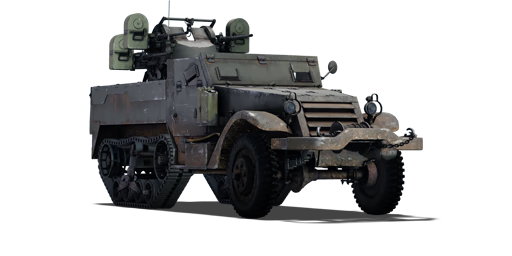
The Multiple Gun Motor Carriage M16 is a rank Japanese SPAA with a battle rating of (AB), (RB), and (SB). It was introduced in Update "Direct Hit".
General info
Survivability and armour
As an open-top half-track, the chassis can only really offer some protection against rifle calibre machine guns, even not completely being true for the anti-air turret, which has a viewport with no glass that can knock out the gunner if aimed at correctly with any kind of small arms.
Armour type:
- Rolled homogeneous armour
| Armour | Front (Slope angle) | Sides | Rear | Roof |
|---|---|---|---|---|
| Hull | 6.35 mm (31°) Hood front 12.7 mm (31°) Driver port |
6.35 mm | 6.35 mm | N/A |
| Turret | 12.7 mm | N/A | N/A | N/A |
Notes:
- Suspension bogies are 10 mm thick, suspension wheels are 15 mm thick, and tracks are 7 mm thick. Front wheels provide 2 mm armour.
Mobility
Decently mobile for a half-track it offers better off-road capability over fully wheeled trucks allowing it to be a decent choice to capture points and even plausible to flank lightly-armoured vehicles with the AP-I belt.
| Game Mode | Max Speed (km/h) | Weight (tons) | Engine power (horsepower) | Power-to-weight ratio (hp/ton) | |||
|---|---|---|---|---|---|---|---|
| Forward | Reverse | Stock | Upgraded | Stock | Upgraded | ||
| Arcade | Expression error: Unexpected * operator. | 210 | Expression error: Unexpected round operator. | __.__ | |||
| Realistic | 131 | Expression error: Unexpected round operator. | __.__ | ||||
Modifications and economy
Armaments
Main armament
| 12.7 mm M2HB (x4) | Turret rotation speed (°/s) | Reloading rate (seconds) | ||||||||||||
|---|---|---|---|---|---|---|---|---|---|---|---|---|---|---|
| Mode | Capacity (Belt) | Fire rate | Vertical | Horizontal | Stabilizer | Stock | Upgraded | Full | Expert | Aced | Stock | Full | Expert | Aced |
| Arcade | 4,800 (200) | 576 | -10°/+90° | ±180° | N/A | 52.8 | 73.1 | 88.8 | 98.2 | 104.5 | 18.20 | 16.10 | 14.84 | 14.00 |
| Realistic | 35.7 | 42.0 | 51.0 | 56.4 | 60.0 | |||||||||
Ammunition
- Common: API-T · I · AP · API-T
- API: API-T · AP-I · API-T
- AP: AP · AP · API-T
- APIT: API-T
| Penetration statistics | ||||||
|---|---|---|---|---|---|---|
| Belt | Penetration @ 0° Angle of Attack (mm) | |||||
| 10 m | 100 m | 500 m | 1,000 m | 1,500 m | 2,000 m | |
| Common | 31 | 29 | 21 | 14 | 9 | 6 |
| API | 30 | 27 | 19 | 12 | 8 | 5 |
| AP | 31 | 29 | 21 | 14 | 9 | 6 |
| APIT | 29 | 27 | 19 | 12 | 7 | 5 |
| Belt details | |||||||||
|---|---|---|---|---|---|---|---|---|---|
| Belt | Type of warhead |
Velocity (m/s) |
Projectile mass (kg) |
Fuse delay (m) |
Fuse sensitivity (mm) |
Explosive mass (TNT equivalent) (g) |
Ricochet | ||
| 0% | 50% | 100% | |||||||
| APIT | API-T | 929 | 0.04 | N/A | N/A | N/A | 47° | 56° | 65° |
Ammo racks

| Full ammo |
1st rack empty |
2nd rack empty |
Visual discrepancy |
|---|---|---|---|
| 24 | 12 (+12) | 0 (+24) | Yes |
Notes:
- Although there are 24 ammo boxes, only 10 are modeled including 4 loaded on the machine guns.
- Since there are four .50 M2HB machine guns, each reload will load 4 ammo boxes onto the guns with each box containing 200 rounds.
Usage in battles
As a lend-lease vehicle from America, the M16 will play exactly like its American counterpart. Posing a large threat to most planes within roughly 1.5 km range, the 4 x .50 cals can shred both plane and pilot after a good burst of direct hits on the plane.
While the M16 and its .50 cals doesn't offer the same explosiveness over Japan's earlier arsenal possessing the Type 98 (20 mm), it does make up for it in sustained fire due to the multiple barrels and larger belts making sure that once engaged with an enemy plane, there are very few moments where the plane can fly easily as long as you keep sights and trigger on it. You can switch target once the plane flies out of range, gets set on fire, or the pilot is knocked out.
Also unlike the previous Army's arsenal of anti-air, the M16 only offers a maximum penetration of 31 mm and purely is meant to shoot down planes with Incendiary rounds. Though some daring tankers might be able to knock out a light tank or two from the side, with the mediocre mobility of a half-track and lacklustre HMGs, it is ill-advised to use this dedicated anti-air in the anti-tank role.
Pros and cons
Pros:
- Strong machine guns that can shred aircraft with a well-aimed burst
- Good mobility; accelerates quickly, fast on flat ground
- Fast turret traverse allows for easily tracking any aircraft
- .50 can knock out open-topped or lightly armoured vehicles
Cons:
- Any armament above light machine guns (>7.92 mm) poses a threat
- Vulnerable to explosive rounds and bombs dropped by aircraft due to it being open top
- Can easily be taken out by an aircraft with one well-aimed pass; the entire crew is exposed
History

Prior to the creation of the Japanese Ground Self-Defense Force in July of 1954, the Japanese were delegated a security force called the "National Safety Force" (NSF) in 1952. Similar in function to the national police, they were trained by American officers and equipped with American military equipment including most firearms and uniforms. Limited under treaty from building their own military designs, Japan sought assistance from the US to provide its heavy equipment. In particular, Japanese personnel were supplied with 168 M16 half-tracks for logistical needs but also close infantry support. M45 turrets with quad .50 cal mountings were supplied from surplus American stocks and fitted to the vehicles. Under the 1st District Force (NSF), the first anti-air units were comprised using the "hand-me-down" M16s. These vehicles would pass into the JGSDF in 1954 and while they would see use until 1974, almost 20 years after America had discontinued their M16s, they eventually were deemed obsolete for their primary purpose.
Media
Excellent additions to the article would be video guides, screenshots from the game, and photos.
See also
Links to the articles on the War Thunder Wiki that you think will be useful for the reader, for example:
- reference to the series of the vehicles;
- links to approximate analogues of other nations and research trees.
External links
Paste links to sources and external resources, such as:
- topic on the official game forum;
- other literature.
| White Motor Company | |
|---|---|
| SPAAs | M13 MGMC · M15 CGMC · M16 MGMC |
| Export | ▅M16 MGMC |
| Japan anti-aircraft vehicles | |
|---|---|
| Ke-Ni Derivatives | Ta-Se · So-Ki |
| Wheeled | Type 94 |
| Tracked | SUB-I-II |
| Radar SPAAG | Type 87 |
| Missile SPAA | Type 93 · Type 81 (C) |
| USA | ▅M16 MGMC · ▅M19A1 · ▅M42 |