Difference between revisions of "ZSU-23-4 (Israel)"
m (→See also) (Tag: Visual edit) |
(most of the info was added, but some is missing) (Tag: Visual edit) |
||
| (13 intermediate revisions by 6 users not shown) | |||
| Line 1: | Line 1: | ||
| − | |||
| − | |||
| − | |||
| − | |||
| − | |||
{{Specs-Card | {{Specs-Card | ||
|code=il_zsu_23_4 | |code=il_zsu_23_4 | ||
| Line 11: | Line 6: | ||
== Description == | == Description == | ||
<!-- ''In the description, the first part should be about the history of the creation and combat usage of the vehicle, as well as its key features. In the second part, tell the reader about the ground vehicle in the game. Insert a screenshot of the vehicle, so that if the novice player does not remember the vehicle by name, he will immediately understand what kind of vehicle the article is talking about.'' --> | <!-- ''In the description, the first part should be about the history of the creation and combat usage of the vehicle, as well as its key features. In the second part, tell the reader about the ground vehicle in the game. Insert a screenshot of the vehicle, so that if the novice player does not remember the vehicle by name, he will immediately understand what kind of vehicle the article is talking about.'' --> | ||
| − | + | The '''{{Specs|name}}''' is a rank {{Specs|rank}} Israeli SPAA {{Battle-rating}}. It was introduced in [[Update "Fire and Ice"]].The "Shilka" presents a much higher rate of fire than its predecessor [[ZSU-57-2]] and allows the user to saturate the airspace to increase the chance of hitting a low-flying aircraft. | |
| − | + | The Shilka preforms more or less like a roided up Wirbelwind, minus the tank hunting ability. As such, the fewer the planes that know your location the better. If one is headed your direction, let them get as close as possible (within reasonable safety, of course) before opening up, to guarantee a hit. The few props and lower rank jets that occur at top rank are easy pickings at most distances due to the wide spread of the 23mm river, but 9.0 jets are trickier to hit, even at medium ranges, so the more of an element of surprise you have, the better. | |
== General info == | == General info == | ||
| Line 28: | Line 23: | ||
! Armour !! Front (Slope angle) !! Sides !! Rear !! Roof | ! Armour !! Front (Slope angle) !! Sides !! Rear !! Roof | ||
|- | |- | ||
| − | | Hull || | + | | Hull || ___ mm || ___ mm ''Top'' <br> ___ mm ''Bottom'' || ___ mm || ___ - ___ mm |
|- | |- | ||
| − | | Turret || | + | | Turret || ___ - ___ mm ''Turret front'' <br> ___ mm ''Gun mantlet'' || ___ - ___ mm || ___ - ___ mm || ___ - ___ mm |
|- | |- | ||
| − | | Cupola || | + | | Cupola || ___ mm || ___ mm || ___ mm || ___ mm |
|- | |- | ||
|} | |} | ||
| Line 38: | Line 33: | ||
'''Notes:''' <!-- Any additional notes which the user needs to be aware of --> | '''Notes:''' <!-- Any additional notes which the user needs to be aware of --> | ||
<!-- Example: * Suspension wheels are 20 mm thick, tracks are 30 mm thick, and torsion bars are 60 mm thick. --> | <!-- Example: * Suspension wheels are 20 mm thick, tracks are 30 mm thick, and torsion bars are 60 mm thick. --> | ||
| − | |||
* Suspension wheels are 20 mm thick while tracks are 15 mm thick. | * Suspension wheels are 20 mm thick while tracks are 15 mm thick. | ||
| − | * Belly armour is | + | * Belly armour is 9.4 mm thick. |
=== Mobility === | === Mobility === | ||
{{Specs-Tank-Mobility}} | {{Specs-Tank-Mobility}} | ||
<!-- ''Write about the mobility of the ground vehicle. Estimate the specific power and manoeuvrability, as well as the maximum speed forwards and backwards.'' --> | <!-- ''Write about the mobility of the ground vehicle. Estimate the specific power and manoeuvrability, as well as the maximum speed forwards and backwards.'' --> | ||
| + | ''Write about the mobility of the ground vehicle. Estimate the specific power and manoeuvrability, as well as the maximum speed forwards and backwards.'' | ||
| − | {{tankMobility | + | {{tankMobility}} |
=== Modifications and economy === | === Modifications and economy === | ||
| Line 57: | Line 52: | ||
<!-- ''Give the reader information about the characteristics of the main gun. Assess its effectiveness in a battle based on the reloading speed, ballistics and the power of shells. Do not forget about the flexibility of the fire, that is how quickly the cannon can be aimed at the target, open fire on it and aim at another enemy. Add a link to the main article on the gun: <code><nowiki>{{main|Name of the weapon}}</nowiki></code>. Describe in general terms the ammunition available for the main gun. Give advice on how to use them and how to fill the ammunition storage.'' --> | <!-- ''Give the reader information about the characteristics of the main gun. Assess its effectiveness in a battle based on the reloading speed, ballistics and the power of shells. Do not forget about the flexibility of the fire, that is how quickly the cannon can be aimed at the target, open fire on it and aim at another enemy. Add a link to the main article on the gun: <code><nowiki>{{main|Name of the weapon}}</nowiki></code>. Describe in general terms the ammunition available for the main gun. Give advice on how to use them and how to fill the ammunition storage.'' --> | ||
{{main|AZP-23 (23 mm)}} | {{main|AZP-23 (23 mm)}} | ||
| + | |||
| + | ''Give the reader information about the characteristics of the main gun. Assess its effectiveness in a battle based on the reloading speed, ballistics and the power of shells. Do not forget about the flexibility of the fire, that is how quickly the cannon can be aimed at the target, open fire on it and aim at another enemy. Add a link to the main article on the gun: <code><nowiki>{{main|Name of the weapon}}</nowiki></code>. Describe in general terms the ammunition available for the main gun. Give advice on how to use them and how to fill the ammunition storage.'' | ||
{| class="wikitable" style="text-align:center" width="100%" | {| class="wikitable" style="text-align:center" width="100%" | ||
| Line 67: | Line 64: | ||
|- | |- | ||
! ''Arcade'' | ! ''Arcade'' | ||
| − | | rowspan="2" | 2,000 (500) || rowspan="2" | 850 || rowspan="2" | -4°/+85° || rowspan="2" | ±180° || rowspan="2" | Two-plane || | + | | rowspan="2" | 2,000 (500) || rowspan="2" | 850 || rowspan="2" | -4°/+85° || rowspan="2" | ±180° || rowspan="2" | Two-plane || __._ || __._ || __._ || __._ || __._ || rowspan="2" | _.__ || rowspan="2" | _.__ || rowspan="2" | _.__ || rowspan="2" | _.__ |
|- | |- | ||
! ''Realistic'' | ! ''Realistic'' | ||
| − | | | + | | __._ || __._ || __._ || __._ || __._ |
|- | |- | ||
|} | |} | ||
| Line 77: | Line 74: | ||
* '''Default:''' {{Annotation|API-T|Armour-piercing incendiary tracer}}{{-}}{{Annotation|HEF-I|High-explosive fragmentation incendiary}} | * '''Default:''' {{Annotation|API-T|Armour-piercing incendiary tracer}}{{-}}{{Annotation|HEF-I|High-explosive fragmentation incendiary}} | ||
| − | * ''' | + | * '''HEI-T:''' {{Annotation|HEF-I|High-explosive fragmentation incendiary}}{{-}}{{Annotation|HEFI-T|High-explosive fragmentation incendiary tracer}}{{-}}{{Annotation|HEF-I|High-explosive fragmentation incendiary}}{{-}}{{Annotation|API-T|Armour-piercing incendiary tracer}} |
| − | * ''' | + | * '''API-T:''' {{Annotation|API-T|Armour-piercing incendiary tracer}}{{-}}{{Annotation|API-T|Armour-piercing incendiary tracer}}{{-}}{{Annotation|API-T|Armour-piercing incendiary tracer}}{{-}}{{Annotation|HEFI-T|High-explosive fragmentation incendiary tracer}} |
| − | { | + | {| class="wikitable sortable" style="text-align:center" width="100%" |
| + | ! colspan="7" | Penetration statistics | ||
| + | |- | ||
| + | ! rowspan="2" data-sort-type="text" | Belt | ||
| + | ! colspan="6" | Penetration @ 0° Angle of Attack (mm) | ||
| + | |- | ||
| + | ! 10 m !! 100 m !! 500 m !! 1,000 m !! 1,500 m !! 2,000 m | ||
| + | |- | ||
| + | | Default || __ || __ || __ || __ || __ || __ | ||
| + | |- | ||
| + | | HEI-T || __ || __ || __ || __ || __ || __ | ||
| + | |- | ||
| + | | API-T || __ || __ || __ || __ || __ || __ | ||
| + | |- | ||
| + | |} | ||
==== [[Ammo racks]] ==== | ==== [[Ammo racks]] ==== | ||
| Line 106: | Line 117: | ||
You have a high ammo count with this vehicle, meaning that you can afford to find a good spot away from the main fight in order to pick off enemy planes. Unless you need to reload your ammo, avoid spawn points. They are usually the hub of most of the fighting and going to them will put you in the firing line. | You have a high ammo count with this vehicle, meaning that you can afford to find a good spot away from the main fight in order to pick off enemy planes. Unless you need to reload your ammo, avoid spawn points. They are usually the hub of most of the fighting and going to them will put you in the firing line. | ||
| − | While it is fully enclosed, the ZSU-23-4 has armour which makes the M18 Hellcat look like a heavy tank. Even 7. | + | While it is fully enclosed, the ZSU-23-4 has armour which makes the M18 Hellcat look like a heavy tank. Even 7.62mm machine guns stand a fair chance of penetrating this vehicle. This makes you a primary target for aircraft, which at this vehicles BR are usually armed with cannons or high penetration machine guns, which will easily take you out. |
| − | + | Top rank helicopters and the FJ-4B VMF 232 are the greatest threat to your existence. They are both capable of sitting comfortably outside your firing range while firing lethal ATGMs at you. Hide from them until they are either dealt with by an allied plane or they come close enough to be dealt with by your 23 mm cannons. | |
=== Pros and cons === | === Pros and cons === | ||
| Line 128: | Line 139: | ||
* Low penetration for 23 mm cannons; means troubles penetrating certain MBTs from the side | * Low penetration for 23 mm cannons; means troubles penetrating certain MBTs from the side | ||
* Radar has very low scan speed | * Radar has very low scan speed | ||
| + | |||
| + | * | ||
== History == | == History == | ||
<!-- ''Describe the history of the creation and combat usage of the vehicle in more detail than in the introduction. If the historical reference turns out to be too long, take it to a separate article, taking a link to the article about the vehicle and adding a block "/History" (example: <nowiki>https://wiki.warthunder.com/(Vehicle-name)/History</nowiki>) and add a link to it here using the <code>main</code> template. Be sure to reference text and sources by using <code><nowiki><ref></ref></nowiki></code>, as well as adding them at the end of the article with <code><nowiki><references /></nowiki></code>. This section may also include the vehicle's dev blog entry (if applicable) and the in-game encyclopedia description (under <code><nowiki>=== In-game description ===</nowiki></code>, also if applicable).'' --> | <!-- ''Describe the history of the creation and combat usage of the vehicle in more detail than in the introduction. If the historical reference turns out to be too long, take it to a separate article, taking a link to the article about the vehicle and adding a block "/History" (example: <nowiki>https://wiki.warthunder.com/(Vehicle-name)/History</nowiki>) and add a link to it here using the <code>main</code> template. Be sure to reference text and sources by using <code><nowiki><ref></ref></nowiki></code>, as well as adding them at the end of the article with <code><nowiki><references /></nowiki></code>. This section may also include the vehicle's dev blog entry (if applicable) and the in-game encyclopedia description (under <code><nowiki>=== In-game description ===</nowiki></code>, also if applicable).'' --> | ||
| − | + | ||
| + | === Development === | ||
| + | The main Soviet self-propelled anti-aircraft vehicle [[ZSU-57-2]], in service since 1955, did not perform satisfactory due to the lack of radar tracking, low rate of fire, and small ammo count for its high-power autocannons. Its firepower was supplemented by the ZPU and ZU series of anti-aircraft mounts using the 14.5 mm and 23 mm armaments respectively. The ZPU and ZU were towed or truck-mounted and had a high rate of fire, but suffered from low mobility when not on a truck and lack of protection if mounted on a truck for a mobile role. It became desirable to combine the traits of these two type of anti-aircraft weaponry together for a tracked anti-aircraft vehicle to be protected, have good mobility, contain a good amount of ammo, and deliver a high rate of fire with heavy-hitting calibre. | ||
| + | |||
| + | Development started in 1957 for this vehicle, ready to be evaluated in 1962. The vehicle went under the name '''ZSU-23-4 "Shilka"''', named after the Shilka River in South-Eastern Russia. The first set of digits signifies the calibre, 23 mm, and the second signifies the number of cannons, 4. Equipped with four water-cooled 23 mm autocannons, the ZSU-23-4 is aimed via manual optics or with a radar that can track aircraft up to 6 km away and guide the armaments to a estimated coordinate. The vehicle can carry up to 2,000 rounds of 23 mm ammunition and each cannon has a fire rate of between 850-1,000 rpm. The ZSU-23-4 was built on a GM-575 chassis, which itself is based off the [[PT-76B|PT-76]]. It was accepted for service by the Soviet Army in 1965 and proceeded to replace all the ZSU-57-2 still in stock by the 1970s. From the time period 1964 to 1982, up to 6,500 ZSU-23-4 were produced at the Mytishchi Engineering Works. | ||
| + | |||
| + | === Combat usage === | ||
| + | The Soviet Army used the ZSU-23-4 as their main anti-aircraft defense weapon. It was intended that the ZSU-23-4 only guard military bases and mechanized formations while the ZSU-37-2, a side development during the Shilka's development period, guard the low-altitude area unable to be hit by surface-to-air missiles. However, the ZSU-23-4 Shilka eventually replaced it to keep a logistics simple. From Soviet doctrine, the Shilkas were organized in anti-aircraft artillery batteries with two platoons of four vehicles each. Initially, one platoon was filled with ZSU-57-2's and the other with Shilkas, but the ZSU-57's were replaced in service by the Shilkas in the 1970s. In the 1970s, the batteries were also reorganized to one platoon of Shilkas and one platoon of anti-air missile systems, both meant to supplement the dead zone from the divisional surface-to-air missile systems. The Shilkas, being very lightly armoured, mainly stay behind the main forces and the front line, ranging between 400 to 1,000 m away from the fighting. Though each Shilka unit fought with their own radar system initially, the implementation of the PPRU-1 allowed for coordinated targeting between the Shilka and missile units against enemy aircraft. Despite their intended role as an anti-aircraft, the high rate of fire, heavy calibre, and ability to elevate the guns at a high angle made it a very popular ground support weapon. This utility made it a very useful weapon in the Soviet occupation of Afghanistan, being able to fight the Mujaheddin ambushing from mountainous terrain. The Soviets also used it during the War against Chechnya, fighting the Chechens in the mountains. The ZSU-23-4 still sees use in the Russian Naval Infantry. | ||
| + | |||
| + | The ZSU-23-4 saw more usage in the hands of the Soviet Union's allies. 2,500 of the Shilkas produced were given out to up to 23 nations. It's most infamous records would come from the hands of the Arabs in the Yom Kippur War in 1973. Using the SA-6 surface-to-air missiles, they forced the Israeli planes to fly low to avoid missile detection and then blasted them away with the Shilkas. The Shilkas also saw use in the later part of the Vietnam War, where they are used nearly the same way by attacking aircraft forced low by missiles. Past that, the ZSU-23-4 saw usage in multiple conflicts in the Third World countries and are still in use today in the Syrian Civil War. | ||
== Media == | == Media == | ||
<!-- ''Excellent additions to the article would be video guides, screenshots from the game, and photos.'' --> | <!-- ''Excellent additions to the article would be video guides, screenshots from the game, and photos.'' --> | ||
| + | ; Skins | ||
| − | + | * [https://live.warthunder.com/feed/camouflages/?vehicle=ussr_zsu_23_4 Skins and camouflages for the ZSU-23-4 from live.warthunder.com.] | |
| − | |||
| − | * [https://live.warthunder.com/feed/camouflages/?vehicle= | ||
== See also == | == See also == | ||
| Line 145: | Line 166: | ||
* ''links to approximate analogues of other nations and research trees.'' --> | * ''links to approximate analogues of other nations and research trees.'' --> | ||
| − | ''' | + | '''Similar role in USSR''' |
| − | * [[ | + | * [[BTR-ZD]] |
| − | ''' | + | '''Analogues on other nations''' |
| − | * [[ | + | * [[M163]] |
* [[SIDAM 25]] | * [[SIDAM 25]] | ||
* [[AMX-30 DCA]] | * [[AMX-30 DCA]] | ||
| − | |||
== External links == | == External links == | ||
| Line 160: | Line 180: | ||
* ''topic on the official game forum;'' | * ''topic on the official game forum;'' | ||
* ''other literature.'' --> | * ''other literature.'' --> | ||
| − | * | + | ''Paste links to sources and external resources, such as:'' |
| + | |||
| + | * ''topic on the official game forum;'' | ||
| + | * ''other literature.'' | ||
{{Israel anti-aircraft vehicles}} | {{Israel anti-aircraft vehicles}} | ||
Revision as of 22:45, 29 October 2022
.jpg)
Contents
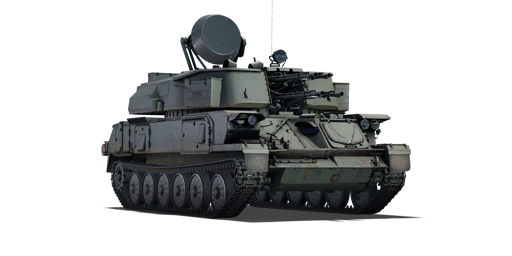
Description
The ZSU-23-4 "Shilka" is a rank Israeli SPAA with a battle rating of (AB), (RB), and (SB). It was introduced in Update "Fire and Ice".The "Shilka" presents a much higher rate of fire than its predecessor ZSU-57-2 and allows the user to saturate the airspace to increase the chance of hitting a low-flying aircraft.
The Shilka preforms more or less like a roided up Wirbelwind, minus the tank hunting ability. As such, the fewer the planes that know your location the better. If one is headed your direction, let them get as close as possible (within reasonable safety, of course) before opening up, to guarantee a hit. The few props and lower rank jets that occur at top rank are easy pickings at most distances due to the wide spread of the 23mm river, but 9.0 jets are trickier to hit, even at medium ranges, so the more of an element of surprise you have, the better.
General info
Survivability and armour
Armour type:
| Armour | Front (Slope angle) | Sides | Rear | Roof |
|---|---|---|---|---|
| Hull | ___ mm | ___ mm Top ___ mm Bottom |
___ mm | ___ - ___ mm |
| Turret | ___ - ___ mm Turret front ___ mm Gun mantlet |
___ - ___ mm | ___ - ___ mm | ___ - ___ mm |
| Cupola | ___ mm | ___ mm | ___ mm | ___ mm |
Notes:
- Suspension wheels are 20 mm thick while tracks are 15 mm thick.
- Belly armour is 9.4 mm thick.
Mobility
Write about the mobility of the ground vehicle. Estimate the specific power and manoeuvrability, as well as the maximum speed forwards and backwards.
| Game Mode | Max Speed (km/h) | Weight (tons) | Engine power (horsepower) | Power-to-weight ratio (hp/ton) | |||
|---|---|---|---|---|---|---|---|
| Forward | Reverse | Stock | Upgraded | Stock | Upgraded | ||
| Arcade | Expression error: Unexpected * operator. | _,___ | __.__ | __.__ | |||
| Realistic | _,___ | __.__ | __.__ | ||||
Modifications and economy
Armaments
Main armament
Give the reader information about the characteristics of the main gun. Assess its effectiveness in a battle based on the reloading speed, ballistics and the power of shells. Do not forget about the flexibility of the fire, that is how quickly the cannon can be aimed at the target, open fire on it and aim at another enemy. Add a link to the main article on the gun: {{main|Name of the weapon}}. Describe in general terms the ammunition available for the main gun. Give advice on how to use them and how to fill the ammunition storage.
| 23 mm AZP-23 (x4) | Turret rotation speed (°/s) | Reloading rate (seconds) | ||||||||||||
|---|---|---|---|---|---|---|---|---|---|---|---|---|---|---|
| Mode | Capacity (Belt) | Fire rate | Vertical | Horizontal | Stabilizer | Stock | Upgraded | Full | Expert | Aced | Stock | Full | Expert | Aced |
| Arcade | 2,000 (500) | 850 | -4°/+85° | ±180° | Two-plane | __._ | __._ | __._ | __._ | __._ | _.__ | _.__ | _.__ | _.__ |
| Realistic | __._ | __._ | __._ | __._ | __._ | |||||||||
Ammunition
- Default: API-T · HEF-I
- HEI-T: HEF-I · HEFI-T · HEF-I · API-T
- API-T: API-T · API-T · API-T · HEFI-T
| Penetration statistics | ||||||
|---|---|---|---|---|---|---|
| Belt | Penetration @ 0° Angle of Attack (mm) | |||||
| 10 m | 100 m | 500 m | 1,000 m | 1,500 m | 2,000 m | |
| Default | __ | __ | __ | __ | __ | __ |
| HEI-T | __ | __ | __ | __ | __ | __ |
| API-T | __ | __ | __ | __ | __ | __ |
Ammo racks
| Full ammo |
1st rack empty |
2nd rack empty |
3rd rack empty |
4th rack empty |
5th rack empty |
6th rack empty |
Visual discrepancy |
|---|---|---|---|---|---|---|---|
| 4 | __ (+__) | __ (+__) | __ (+__) | __ (+__) | __ (+__) | __ (+__) | __ |
Usage in battles
The ZSU-23-4 should be played entirely as an AA vehicle. Do not go tank hunting in this vehicle, as you do not have the armour or the penetration. Focus on keeping the skies clear, something that this vehicle does very well. A high rate of fire and very fast turret traverse means that you should be able to target and destroy even the fastest jets.
You have a high ammo count with this vehicle, meaning that you can afford to find a good spot away from the main fight in order to pick off enemy planes. Unless you need to reload your ammo, avoid spawn points. They are usually the hub of most of the fighting and going to them will put you in the firing line.
While it is fully enclosed, the ZSU-23-4 has armour which makes the M18 Hellcat look like a heavy tank. Even 7.62mm machine guns stand a fair chance of penetrating this vehicle. This makes you a primary target for aircraft, which at this vehicles BR are usually armed with cannons or high penetration machine guns, which will easily take you out.
Top rank helicopters and the FJ-4B VMF 232 are the greatest threat to your existence. They are both capable of sitting comfortably outside your firing range while firing lethal ATGMs at you. Hide from them until they are either dealt with by an allied plane or they come close enough to be dealt with by your 23 mm cannons.
Pros and cons
Pros:
- High rate of fire; allows for area saturation
- Relatively high top speed
- High ammo count
- Fast turret traverse
- Can penetrate lightly armoured vehicles (other SPAAs)
- Radar-assisted fire control; a lead indicator is shown in Realistic.
Cons:
- Thin armour; aircraft cannons will cause severe damage
- Low power to weight ratio; struggles with slopes and off-road
- Low penetration for 23 mm cannons; means troubles penetrating certain MBTs from the side
- Radar has very low scan speed
History
Development
The main Soviet self-propelled anti-aircraft vehicle ZSU-57-2, in service since 1955, did not perform satisfactory due to the lack of radar tracking, low rate of fire, and small ammo count for its high-power autocannons. Its firepower was supplemented by the ZPU and ZU series of anti-aircraft mounts using the 14.5 mm and 23 mm armaments respectively. The ZPU and ZU were towed or truck-mounted and had a high rate of fire, but suffered from low mobility when not on a truck and lack of protection if mounted on a truck for a mobile role. It became desirable to combine the traits of these two type of anti-aircraft weaponry together for a tracked anti-aircraft vehicle to be protected, have good mobility, contain a good amount of ammo, and deliver a high rate of fire with heavy-hitting calibre.
Development started in 1957 for this vehicle, ready to be evaluated in 1962. The vehicle went under the name ZSU-23-4 "Shilka", named after the Shilka River in South-Eastern Russia. The first set of digits signifies the calibre, 23 mm, and the second signifies the number of cannons, 4. Equipped with four water-cooled 23 mm autocannons, the ZSU-23-4 is aimed via manual optics or with a radar that can track aircraft up to 6 km away and guide the armaments to a estimated coordinate. The vehicle can carry up to 2,000 rounds of 23 mm ammunition and each cannon has a fire rate of between 850-1,000 rpm. The ZSU-23-4 was built on a GM-575 chassis, which itself is based off the PT-76. It was accepted for service by the Soviet Army in 1965 and proceeded to replace all the ZSU-57-2 still in stock by the 1970s. From the time period 1964 to 1982, up to 6,500 ZSU-23-4 were produced at the Mytishchi Engineering Works.
Combat usage
The Soviet Army used the ZSU-23-4 as their main anti-aircraft defense weapon. It was intended that the ZSU-23-4 only guard military bases and mechanized formations while the ZSU-37-2, a side development during the Shilka's development period, guard the low-altitude area unable to be hit by surface-to-air missiles. However, the ZSU-23-4 Shilka eventually replaced it to keep a logistics simple. From Soviet doctrine, the Shilkas were organized in anti-aircraft artillery batteries with two platoons of four vehicles each. Initially, one platoon was filled with ZSU-57-2's and the other with Shilkas, but the ZSU-57's were replaced in service by the Shilkas in the 1970s. In the 1970s, the batteries were also reorganized to one platoon of Shilkas and one platoon of anti-air missile systems, both meant to supplement the dead zone from the divisional surface-to-air missile systems. The Shilkas, being very lightly armoured, mainly stay behind the main forces and the front line, ranging between 400 to 1,000 m away from the fighting. Though each Shilka unit fought with their own radar system initially, the implementation of the PPRU-1 allowed for coordinated targeting between the Shilka and missile units against enemy aircraft. Despite their intended role as an anti-aircraft, the high rate of fire, heavy calibre, and ability to elevate the guns at a high angle made it a very popular ground support weapon. This utility made it a very useful weapon in the Soviet occupation of Afghanistan, being able to fight the Mujaheddin ambushing from mountainous terrain. The Soviets also used it during the War against Chechnya, fighting the Chechens in the mountains. The ZSU-23-4 still sees use in the Russian Naval Infantry.
The ZSU-23-4 saw more usage in the hands of the Soviet Union's allies. 2,500 of the Shilkas produced were given out to up to 23 nations. It's most infamous records would come from the hands of the Arabs in the Yom Kippur War in 1973. Using the SA-6 surface-to-air missiles, they forced the Israeli planes to fly low to avoid missile detection and then blasted them away with the Shilkas. The Shilkas also saw use in the later part of the Vietnam War, where they are used nearly the same way by attacking aircraft forced low by missiles. Past that, the ZSU-23-4 saw usage in multiple conflicts in the Third World countries and are still in use today in the Syrian Civil War.
Media
- Skins
See also
Similar role in USSR
Analogues on other nations
External links
Paste links to sources and external resources, such as:
- topic on the official game forum;
- other literature.
| Israel anti-aircraft vehicles | |
|---|---|
| Half-track | TCM-20 |
| M163 derivatives | Hovet · Machbet · Imp.Chaparral |
| Captured | ZSU-57-2 · ZSU-23-4 |