Difference between revisions of "BT-7M"
(→Survivability and armour) (Tag: Visual edit) |
(→Survivability and armour) (Tag: Visual edit) |
||
| Line 17: | Line 17: | ||
{{Specs-Tank-Armour}} | {{Specs-Tank-Armour}} | ||
<!-- ''Describe armour protection. Note the most well protected and key weak areas. Appreciate the layout of modules as well as the number and location of crew members. Is the level of armour protection sufficient, is the placement of modules helpful for survival in combat? If necessary use a visual template to indicate the most secure and weak zones of the armour.'' -->The armour of the BT-7M features noteable improvements over the preceding BT-7. The frontal hull and the frontal half of the side hull are now 20mm, which makes it more effective at deflecting bullets/autocannon shells when angled and/or at a distance. Vehicles such as [[M16 MGMC]] and [[Flakpanzer 38]] now might be somewhat less threatening due to your increased hull armour. The turret, however, keeps the same armour, which is 13-15mm all-round. This is inadequate to stop HMG bullets and any AP or even HE shells at any distance. It can only resist rifle caliber bullets from vehicles like [[Light AA Mk I]]. Overall, despite the thickened hull, the BT-7M is still protected in a light tank style and should not risk to take any hits. | <!-- ''Describe armour protection. Note the most well protected and key weak areas. Appreciate the layout of modules as well as the number and location of crew members. Is the level of armour protection sufficient, is the placement of modules helpful for survival in combat? If necessary use a visual template to indicate the most secure and weak zones of the armour.'' -->The armour of the BT-7M features noteable improvements over the preceding BT-7. The frontal hull and the frontal half of the side hull are now 20mm, which makes it more effective at deflecting bullets/autocannon shells when angled and/or at a distance. Vehicles such as [[M16 MGMC]] and [[Flakpanzer 38]] now might be somewhat less threatening due to your increased hull armour. The turret, however, keeps the same armour, which is 13-15mm all-round. This is inadequate to stop HMG bullets and any AP or even HE shells at any distance. It can only resist rifle caliber bullets from vehicles like [[Light AA Mk I]]. Overall, despite the thickened hull, the BT-7M is still protected in a light tank style and should not risk to take any hits. | ||
| + | |||
| + | The post-penetration survivability is just as poor as the other BT models. The only 3 crew are closely packed, with the gunner and commander right next to each other in the turret, and the driver directly in front of them. Any penetrating shots, regardless of explosive or solid, will have no issue taking out most/all of them. The weak armour also leads to the crew being vulnerable to over pressure damage. Vehicles with large caliber guns like the [[15cm sIG 33 B Sfl|Sturmpanzer II]] and [[M4A3 (105)]] will easily destroy the BT-7M with a single HE shell. The only positive aspect is the large fuel tanks at the rear hull sides, outside the engine. These fuel tanks protect the engine by absorbing poorly aimed shots although they might be set aflame, thus keeping the BT-7M driveable for a few more seconds. | ||
'''Armour type:''' | '''Armour type:''' | ||
Revision as of 03:38, 17 December 2021
| This page is about the Soviet light tank BT-7M. For other versions, see BT-7 (Family). |

Contents
Description
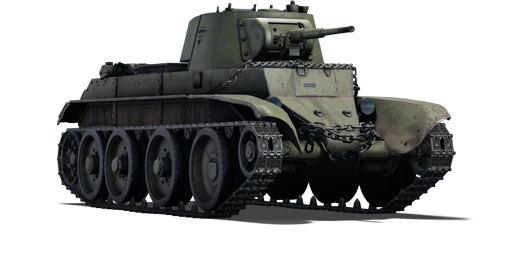
The BT-7M is a rank Soviet light tank with a battle rating of (AB), (RB), and (SB). It was introduced in Update "Ixwa Strike".
General info
Survivability and armour
The armour of the BT-7M features noteable improvements over the preceding BT-7. The frontal hull and the frontal half of the side hull are now 20mm, which makes it more effective at deflecting bullets/autocannon shells when angled and/or at a distance. Vehicles such as M16 MGMC and Flakpanzer 38 now might be somewhat less threatening due to your increased hull armour. The turret, however, keeps the same armour, which is 13-15mm all-round. This is inadequate to stop HMG bullets and any AP or even HE shells at any distance. It can only resist rifle caliber bullets from vehicles like Light AA Mk I. Overall, despite the thickened hull, the BT-7M is still protected in a light tank style and should not risk to take any hits.
The post-penetration survivability is just as poor as the other BT models. The only 3 crew are closely packed, with the gunner and commander right next to each other in the turret, and the driver directly in front of them. Any penetrating shots, regardless of explosive or solid, will have no issue taking out most/all of them. The weak armour also leads to the crew being vulnerable to over pressure damage. Vehicles with large caliber guns like the Sturmpanzer II and M4A3 (105) will easily destroy the BT-7M with a single HE shell. The only positive aspect is the large fuel tanks at the rear hull sides, outside the engine. These fuel tanks protect the engine by absorbing poorly aimed shots although they might be set aflame, thus keeping the BT-7M driveable for a few more seconds.
Armour type:
- Rolled homogeneous armour (hull, turret)
| Armour | Front (Slope angle) | Sides | Rear | Roof |
|---|---|---|---|---|
| Hull | 20 mm (18°) Upper plate 15 mm (61°) Middle plate 20 mm Lower plate |
20 mm Forward 15 mm + 4 mm Rearward |
10-13 mm | 10 mm Roof 4 mm Radiator grilles |
| Turret | 15 mm Turret front 15 mm Gun mantlet |
15 mm Forward 13 mm Rearward |
13 mm | 10 mm |
Notes:
- Suspension wheels, tracks and torsion bars are 15 mm thick.
- Belly armour is 6 mm thick.
Mobility
| Game Mode | Max Speed (km/h) | Weight (tons) | Engine power (horsepower) | Power-to-weight ratio (hp/ton) | |||
|---|---|---|---|---|---|---|---|
| Forward | Reverse | Stock | Upgraded | Stock | Upgraded | ||
| Arcade | Expression error: Unexpected * operator. | 775 | Expression error: Unexpected round operator. | __.__ | |||
| Realistic | 442 | Expression error: Unexpected round operator. | __.__ | ||||
Modifications and economy
Armaments
Main armament
| 45 mm 20-K | Turret rotation speed (°/s) | Reloading rate (seconds) | |||||||||||
|---|---|---|---|---|---|---|---|---|---|---|---|---|---|
| Mode | Capacity | Vertical | Horizontal | Stabilizer | Stock | Upgraded | Full | Expert | Aced | Stock | Full | Expert | Aced |
| Arcade | 188 | -5°/+20° | ±180° | N/A | 15.2 | 21.1 | 25.6 | 28.3 | 30.1 | 3.77 | 3.33 | 3.07 | 2.90 |
| Realistic | 9.5 | 11.2 | 13.6 | 15.0 | 16.0 | ||||||||
Ammunition
| Penetration statistics | |||||||
|---|---|---|---|---|---|---|---|
| Ammunition | Type of warhead |
Penetration @ 0° Angle of Attack (mm) | |||||
| 10 m | 100 m | 500 m | 1,000 m | 1,500 m | 2,000 m | ||
| BR-240 | APHEBC | 70 | 68 | 59 | 50 | 42 | 35 |
| BR-240SP | AP | 73 | 71 | 62 | 52 | 44 | 37 |
| Shell details | |||||||||
|---|---|---|---|---|---|---|---|---|---|
| Ammunition | Type of warhead |
Velocity (m/s) |
Projectile Mass (kg) |
Fuse delay (m) |
Fuse sensitivity (mm) |
Explosive Mass (TNT equivalent) (g) |
Ricochet | ||
| 0% | 50% | 100% | |||||||
| BR-240 | APHEBC | 760 | 1.43 | 1.2 | 9 | 29.26 | 48° | 63° | 71° |
| BR-240SP | AP | 757 | 1.43 | N/A | N/A | N/A | 47° | 60° | 65° |
Ammo racks

| Full ammo |
1st rack empty |
2nd rack empty |
3rd rack empty |
4th rack empty |
5th rack empty |
6th rack empty |
7th rack empty |
|---|---|---|---|---|---|---|---|
| 188 | 174 (+14) | 162 (+26) | 147 (+41) | 135 (+53) | 123 (+65) | 108 (+80) | 89 (+99) |
| 8th rack empty |
9th rack empty |
10th rack empty |
11th rack empty |
12th rack empty |
13th rack empty |
Visual discrepancy |
|
| 73 (+115) | 57 (+131) | 41 (+147) | 25 (+163) | 13 (+175) | 1 (+187) | No |
Notes:
- Racks disappear after you've fired all shells in the rack.
- Turret empty: 147 (+41) shells.
- Turret and side racks empty: 89 (+99) shells.
Machine guns
| 7.62 mm DT | ||||
|---|---|---|---|---|
| Mount | Capacity (Belt) | Fire rate | Vertical | Horizontal |
| Coaxial | 1,890 (63) | 600 | N/A | N/A |
Usage in battles
Describe the tactics of playing in the vehicle, the features of using vehicles in the team and advice on tactics. Refrain from creating a "guide" - do not impose a single point of view but instead give the reader food for thought. Describe the most dangerous enemies and give recommendations on fighting them. If necessary, note the specifics of the game in different modes (AB, RB, SB).
Pros and cons
Summarise and briefly evaluate the vehicle in terms of its characteristics and combat effectiveness. Mark its pros and cons in a bulleted list. Try not to use more than 6 points for each of the characteristics. Avoid using categorical definitions such as "bad", "good" and the like - use substitutions with softer forms such as "inadequate" and "effective".
Pros:
- Upgraded engine compared to the previous BT-7
- Fast-firing gun
- Exceptionally nimble, being able to turn its hull very quickly
Cons:
- Sits at a higher BR than the previous BT-7
- Armour remains thin, with heavy machine guns being able to penetrate and knock out crew members
- Only 3 crew members
- Oversteers at high speed, leading to it spinning out and/or drifting and loosing its speed
History
The BT-7M was an improved version of the Soviet BT-7 light tank developed before the Second World War. The main improvement was in terms of the powerplant, and at the time it was built no other tank in the world could reach the same speeds.[1]
Development
Development of a version of the BT-7 light tank began in the Soviet Union in 1938 with the construction of four prototypes at the Kharkov Locomotive Plant called the BT-8, which used a V12 diesel engine which was developed from the Hispano-Suiza 12Y aircraft engine. After the BT-8 was tested against the BT-7 it was determined to continue its development which resulted in the production version, designated BT-7M.[1][2]
Design
The BT-7M had the 500 horsepower V12 engine which was actually chosen partly due to greater fuel efficiency. The hull was reinforced with braces and some of the fuel storage was removed due to the higher fuel efficiency of the engine. The BT-7M’s engine also proved to be much safer in that it caught on fire much less often when hit by enemy fire. The BT-7M was proven to have a top speed of 62 km/h on tracks and 86 km/h with just wheels. Other than these changes, the BT-7M was fairly similar to the regular BT-7.[1][2]
Production and Service
The BT-7M entered production in 1939, replacing all earlier BT-7 variants on production lines. It was the last BT-7 variant produced with production lasting until 1941. Approximately 788 BT-7M tanks were built during that time period, being superseded on production lines by the T-34 medium tank. The BT-7M did end up seeing some combat during the Great Patriotic War.[1][2]
Media
- Skins
- Videos
See also
Links to the articles on the War Thunder Wiki that you think will be useful for the reader, for example:
- reference to the series of the vehicles;
- links to approximate analogues of other nations and research trees.
External links
Paste links to sources and external resources, such as:
- topic on the official game forum;
- other literature.
References
| USSR light tanks | |
|---|---|
| T-26 | T-26 · T-26 (1st Gv.T.Br.) · T-26-4 · T-26E |
| BT | BT-5 · RBT-5 · BT-7 · BT-7 TD · BT-7M · BT-7A (F-32) |
| T-50 | T-126 · T-50 |
| T-70 | T-70 · T-80 |
| PT-76 | PT-76B · PT-76-57 · Object 906 |
| BMP | BMP-1 · BMP-2 · BMP-2M · BMP-3 |
| BMD | BMD-4 |
| 2S25 | 2S25 · 2S25M |
| Wheeled | BA-11 · BTR-80A |
| Other | T-60 · Object 685 · 2S38 |
| China | ▂Type 62 |