IJN Fuso

Contents
Description
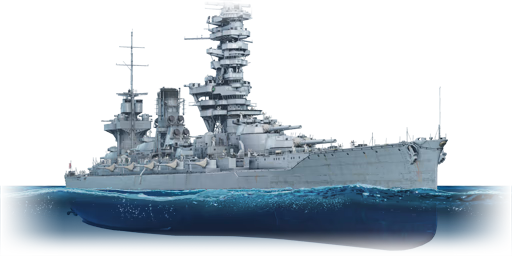
The Fuso-class, IJN Fuso, 1944 (扶桑, namesake: classical name for Japan) was the first of her class and a symbol of Japan's naval power in the early 20th century. She was designed to maintain Japan's supremacy in the Pacific against the United States and Great Britain, following Japan's victory over Russia at Tsushima in 1905. Fuso had an ever growing distinction: a towering pagoda mast that housed her fire control and observation equipment that grew with nearly every modernization. However, despite undergoing several modernizations and reconstructions, Fuso could not keep up with the newer and faster battleships of Japan and other countries. She was primarily relegated to auxiliary roles during World War II, such as troop transport and training.
IJN Fuso was introduced in Update "Fire and Ice". She has six turrets with twin 356 mm cannons, which can fire a powerful broadside of twelve 356 mm shells every 30 seconds. Fuso appears in War Thunder in her 1944 modernization, which includes a large array of anti-air guns, mostly consisting of the infamous Type 96 (25 mm). These guns are inaccurate and unreliable individually, but in large numbers (Fuso has 89 in total) they create a massive barrage of lead that can deter aerial targets at close to medium range. However, the Fuso also has low mobility, with a top speed of only 23 knots and a large turning radius. Therefore, Fuso is best suited for long-range engagements where she can use her superior firepower to her advantage.
General info
Survivability and armour
Talk about the vehicle's armour. Note the most well-defended and most vulnerable zones, e.g. the ammo magazine. Evaluate the composition of components and assemblies responsible for movement and manoeuvrability. Evaluate the survivability of the primary and secondary armaments separately. Don't forget to mention the size of the crew, which plays an important role in fleet mechanics. Save tips on preserving survivability for the "Usage in battles" section. If necessary, use a graphical template to show the most well-protected or most vulnerable points in the armour.
Mobility
Write about the ship's mobility. Evaluate its power and manoeuvrability, rudder rerouting speed, stopping speed at full tilt, with its maximum forward and reverse speed.
| Mobility Characteristics | |||
|---|---|---|---|
| Game Mode | Upgrade Status | Maximum Speed (km/h) | |
| Forward | Reverse | ||
| AB | |||
| Upgraded | |||
| RB/SB | |||
| Upgraded | |||
Modifications and economy
Armament
Primary armament
Provide information about the characteristics of the primary armament. Evaluate their efficacy in battle based on their reload speed, ballistics and the capacity of their shells. Add a link to the main article about the weapon: {{main|Weapon name (calibre)}}. Broadly describe the ammunition available for the primary armament, and provide recommendations on how to use it and which ammunition to choose.
| Penetration statistics | |||||||
|---|---|---|---|---|---|---|---|
| Ammunition | Type of warhead |
Penetration @ 0° Angle of Attack (mm) | |||||
| 1,000 m | 2,500 m | 5,000 m | 7,500 m | 10,000 m | 15,000 m | ||
| Ordinary SAP | SAPCBC | 301 | 280 | 248 | 222 | 199 | 168 |
| Type 91 APC | APCBC | 635 | 593 | 529 | 476 | 431 | 366 |
| Common Type 0 | HE | 67 | 67 | 67 | 67 | 67 | 67 |
| Shell details | ||||||||||||
|---|---|---|---|---|---|---|---|---|---|---|---|---|
| Ammunition | Type of warhead |
Velocity (m/s) |
Projectile mass (kg) |
Fuse delay (s) |
Fuse sensitivity (mm) |
Explosive mass (TNT equivalent) (kg) |
Ricochet | |||||
| 0% | 50% | 100% | ||||||||||
| Ordinary SAP | SAPCBC | 780 | 635.58 | 0.01 | 26 | 68.64 | 48° | 63° | 71° | |||
| Type 91 APC | APCBC | 771 | 671.3 | 0.05 | 26 | 11.66 | 48° | 63° | 71° | |||
| Common Type 0 | HE | 805 | 621 | 0 | 0.1 | 31 | 79° | 80° | 81° | |||
Secondary armament
Some ships are fitted with weapons of various calibres. Secondary armaments are defined as weapons chosen with the control Select secondary weapon. Evaluate the secondary armaments and give advice on how to use them. Describe the ammunition available for the secondary armament. Provide recommendations on how to use them and which ammunition to choose. Remember that any anti-air armament, even heavy calibre weapons, belong in the next section. If there is no secondary armament, remove this section.
| Penetration statistics | |||||||
|---|---|---|---|---|---|---|---|
| Ammunition | Type of warhead |
Penetration @ 0° Angle of Attack (mm) | |||||
| 1,000 m | 2,500 m | 5,000 m | 7,500 m | 10,000 m | 15,000 m | ||
| Type 0 HE | HE | 35 | 35 | 35 | 35 | 35 | 35 |
| Type 4 SAP | SAP | 81 | 68 | 52 | 40 | 34 | 34 |
| Shell details | ||||||||||||
|---|---|---|---|---|---|---|---|---|---|---|---|---|
| Ammunition | Type of warhead |
Velocity (m/s) |
Projectile mass (kg) |
Fuse delay (s) |
Fuse sensitivity (mm) |
Explosive mass (TNT equivalent) (kg) |
Ricochet | |||||
| 0% | 50% | 100% | ||||||||||
| Type 0 HE | HE | 850 | 45.26 | 0 | 0.1 | 3.17 | 79° | 80° | 81° | |||
| Type 4 SAP | SAP | 850 | 45.26 | 0.01 | 7 | 2.92 | 47° | 60° | 65° | |||
Anti-aircraft armament
An important part of the ship's armament responsible for air defence. Anti-aircraft armament is defined by the weapon chosen with the control Select anti-aircraft weapons. Talk about the ship's anti-air cannons and machine guns, the number of guns and their positions, their effective range, and about their overall effectiveness – including against surface targets. If there are no anti-aircraft armaments, remove this section.
Usage in battles
Describe the technique of using this ship, the characteristics of her use in a team and tips on strategy. Abstain from writing an entire guide – don't try to provide a single point of view, but give the reader food for thought. Talk about the most dangerous opponents for this vehicle and provide recommendations on fighting them. If necessary, note the specifics of playing with this vehicle in various modes (AB, RB, SB).
Pros and cons
Pros:
- Effective guns
- Effective anti-air suite
- Adequate armour that can absorb damage
- Large crew complement
Cons:
- Long reload time on main batteries
- Slow cruise speed
- Extremely long turn time
History
Describe the history of the creation and combat usage of the ship in more detail than in the introduction. If the historical reference turns out to be too long, take it to a separate article, taking a link to the article about the ship and adding a block "/History" (example: https://wiki.warthunder.com/(Ship-name)/History) and add a link to it here using the main template. Be sure to reference text and sources by using <ref></ref>, as well as adding them at the end of the article with <references />. This section may also include the ship's dev blog entry (if applicable) and the in-game encyclopedia description (under === In-game description ===, also if applicable).
Media
- Skins
See also
Links to articles on the War Thunder Wiki that you think will be useful for the reader, for example:
- reference to the series of the ship;
- links to approximate analogues of other nations and research trees.
External links
| Kure Naval Arsenal (呉海軍工廠) | |
|---|---|
| Heavy Cruisers (CA) | |
| Mogami-class | IJN Mogami* |
| Battlecruisers (BC) | |
| Tsukuba-class | IJN Ikoma |
| Battleships (BB) | |
| Kawachi-class | IJN Settsu |
| Fusō-class | IJN Fuso |
| Note | *Initially built as a CL with 15.5 cm cannons, refitted with 20.3 cm and reclassified as a CA |
| Japan battleships | |
|---|---|
| Kawachi-class | IJN Settsu |
| Fusō-class | IJN Fuso · IJN Yamashiro |
| Ise-class | IJN Ise · IJN Hyuga |
| Kongō-class | IJN Kongo · IJN Haruna |
| Nagato-class | IJN Mutsu |